


Page 9 - (DK Eyewitness) Travel Guide - Estonia Latvia & Lithuania
P. 9
HOW T O USE THIS GUIDE 7
234 LITHU ANIA REGION B Y REGION VILNIUS 235
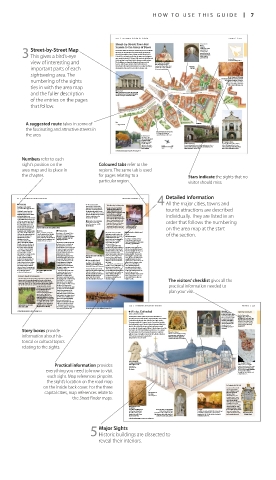
Street-by-Street: Town Hall Šv Kazimiero
Street
Square to the Gates of Dawn A narrow
Street-by-Street Map Lithuania’s distinctive Baroque architecture, known as Vilnius cobblestone street
named after St
Baroque, can be admired in the outstanding monuments Casimir snakes
around the back of
3 This gives a bird’s-eye clustered around the Gates of Dawn and the Church of St the church towards
Užupis, with its
Casimir. The enchanting collection of towers and sculptures
was created during the 17th and 18th centuries by Italian and jumble of roofs. Locator Map
view of interesting and Polish architects and their Polish-Lithuanian noble patrons. f. Church of St Casimir See Street Finder Map pp250–51
The buildings are elegantly designed with symmetrical
façades, reflecting an unmistakable Italian influence.
museum of atheism from 1963
Nonetheless, the mystical atmosphere, so unique to Vilnius, This church was the city’s Church of the
important parts of each distinguishes the area from any other European city. to 1991. The crown symbolizes Holy Spirit
St Casimir’s royal lineage.
sightseeing area. The j . Church of St Theresa
numbering of the sights S U B A Č I A U S G A T V Ė Scenes from the life of St Theresa, revered
for her mystical writings, adorn the
vaulted nave of the church. The
frescoes were pain ted in the late
ties in with the area map D I D Ž I O J I G A T V Ė M D A U K Š O S G A T V Ė 18th century following a fire.
s Town Hall
and the fuller description With a bold Classical portico, the Town Hall A U Š R O S V A R T Ų G A T V Ė
was designed by the renowned Lithuanian
architect Laurynas Stuoka-Gucevičius.
of the entries on the pages
that follow.
V O K I E Č I Ų G A T V Ė R Ū D N I N K ų G A T V Ė A R K L I ų G A T V Ė B A Z I L I J O N Ų G A T V Ė
A suggested route takes in some of Key Suggested route Basilian Gate
the fascinating and attractive streets in
is a Soviet-era venue for
the area. Vokiečių Street d Contemporary Art Centre
groundbreaking modern art.
One of the city’s
oldest, Vokiečių Street
resembles a park
during the summer k. Gates of Dawn
months, with its Basilian Monastery A site of pilgrimage, this gateway
outdoor cafés and a 0 metres 100 The now dilapidated monastery complex was used as a to the Old Town pro tects a silver-
plea sant central tree- 0 yards 100 prison to hold anti-Russian activists, including the poet covered painting of the Virgin Mary,
lined walkway. Adam Mickiewicz, in the 1820s. said to have miraculous powers.
For hotels and restaurants see pp304–305 and pp326–8
Numbers refer to each
sight’s position on the Coloured tabs refer to the
area map and its place in regions. The same tab is used
the chapter. for pages relating to a Stars indicate the sights that no
particular region. visitor should miss.
Detailed Information
92 EST ONIA REGION B Y REGION WESTERN EST ONIA 93
4 All the major cities, towns and
1 Paldiski On the east coast, the Tchaikovsky in Haapsalu
promenade is another fine
Road Map C1. * 4,000. £ legacy of the town’s imperial Russian composer Pyotr Ilyich
@ 145 from Tallinn. ∑ paldiski.ee
glory days. From Africa Beach Tchaikovsky and his brothers tourist attractions are described
Deriving its name from the the promenade winds its way Anatoly and Modest spent the
Estonian pronunciation of past the spa hall at Kuursaal and summer of 1867 in Haapsalu. Living
baltiyskiy, which means “Baltic” leads to the Museum of Coastal in a small house on Suur-Mere individually. They are listed in an
in Russian, Paldiski was Swedes, which traces the worked on The Voyevoda, his first
Street, the 27-year-old Pyotr
established by Peter the Great in history of the Swedes. opera and one of his major compo-
1718. Paldiski was known to be sitions. Tchaikovsky Bench on the
of strategic impor tance for the E Museum of Coastal Swedes promenade commem orates his order that follows the numbering
Russian Empire. In 1962, when Sadama 31/32. Tel 473 7165. stay and, at the press of a button,
the Soviet Navy nuclear sub- Open 11am–4pm Tue–Sat. & blares out a part of the Sixth
marine training centre was set ∑ aiboland.ee Symphony, thought to have been Tchaikovsky Bench on the
up here, the area already had Haapsalu’s medieval castle, with an adjoining cathedral inspired by an Estonian folk song. promenade in Haapsalu on the area map at the start
two nuclear reactors and
employed some 16,000 people. Environs 2 Haapsalu
The Soviets finally withdrew in Pakri, a stunning peninsula Road Map C2. * 12,000. @ from the island and its beautiful 4 Matsalu National
1994 and the town quickly fell 3 km (2 miles) west of Paldiski, Tallinn. g from Hiiumaa, Vormsi. landscapes make it perfect for Park of the section.
into chronic disrepair. The boasts Estonia’s tallest light- n Karja 15, 473 3248. _ Early Music hiking and cycling. The island Matsalu rahvuspark
Swedish director Lukas house. Also here are the ruins of Festival (4–8 Jul), White Lady Days is well known for its lush
Moodysson shot his Peter the Great’s ambitious but (Aug). ∑ haapsalu.ee pine forests and an abundance Road Map C2. n Matsalu Nature
extraordinarily bleak film unfinished fortress project. of juniper bushes, as well as Centre, Penijõe Manor; 472 4236.
Lilya-4-Ever (2002) in Paldiski, Situated on a small spit of land spectacular stretches of Open 9am–5pm Mon–Fri, 10am–6pm
though it was described as an jutting out into a narrow bay, rocky coastline. Sat & Sun. 8 ∑ matsalu.ee
unnamed “former republic of the popular resort town of Some people believe that
the Soviet Union” in the film. Haapsalu dates back to the 13th Vormsi means “Snakes Island”, as Situated around the narrow
Located 52 km (32 miles) century. Its impressive Bishop’s the name derives from the old Matsalu Bay, Matsalu National
west of Tallinn, Paldiski is a Castle ruins still serve as the Swedish word for snake. Others, Park was founded in 1957 as a
fascinating place to visit main focal point for the town, however, claim that it was sanctuary for nesting and
and it attracts a steady stream despite the fact that its named after a pirate called Orm. migratory birds. The area is a
of tourists. The countless formidable fortifica tions were Picturesque houses in one of the villages on Either way, Vormsi Island was bird-watcher’s paradise, with
derelict military buildings largely dismantled by Peter the Vormsi Island home to some 2,000 Swedes some 275 species found in its
testify to the prominent role Great in the 18th century. The prior to World War II, and their coastal wetlands. Six obser-
Paldiski once played in the castle watchtower houses the 3 Vormsi Island influence can be seen all over vation towers dotted along the
Soviet defence system. Today, Castle Museum, displaying Road Map C1. * 350. @ from the island. coast offer the chance to see
how ever, the town is slowly medieval weaponry. The Haapsalu. g from Rohuküla, 10 km The island’s main settlement the fauna and birdlife up
but surely being revitalized. adjoining Dome Cathedral is (6 miles) W of Haapsalu. ∑ vormsi.ee is Hullo, 3 km (2 miles) west of close. Viewing platforms
The port area is booming and the largest single-nave church the ferry port at Sviby. The overlook some of the islets
Paldiski’s natural beauty makes in the Baltic region. Estonia’s fourth-largest island, 14th-century St Olav’s Church and coastal meadows. Most
it an attractive site for The red-painted lighthouse at Pakri, Over the course of the 19th Vormsi is only 10 km (6 miles) by is especially worth visiting for its of the observation towers are
residential development. near Paldiski century, Haapsalu became a 20 km (12 miles) in size. The Baroque pulpit and a cemetery reached by car or bus,
fashionable holiday resort, island is ruggedly beautiful and with a striking collection of although Penijõe tower, on the
Estonia’s Swedish Community famed for its curative mud blissfully unspoiled despite circular Swedish crosses bank of the Penijõe river, is a
short walk from the Matsalu
looming out of hand-made
being only 3 km (2 miles)
treatments and pretty beaches.
Swedish settlers in Estonia were first mentioned in 1294 in Haapsalu’s Its landmark 216-m (709-ft) long from the mainland. The size of mounds of grass. Nature Centre.
town records. It is generally thought that Swedes settled along train platform is an enduring The visitors’ checklist gives all the
the western coastal areas in the 13th and 14th centuries to secure monument to the era when
trade routes. From 1561 to 1700 Estonia was directly under Swedish Russian royalty and high society
rule. By the early 20th century, there were some 8,000 Swedish- flocked to the town every practical information needed to
speaking Estonians, most of summer. The platform was built
whom lived on Vormsi Island and in 1904 to receive Tsar Nicholas
in the Haapsalu region. The II and his entourage, and its
Estonian-Swedes were a ornate wooden canopy was plan your visit.
recognized minority with their designed to protect them from
own periodical and distinct bad weather. The station closed
cultural identity. How ever, the
majority of them fled to Sweden in 1995 and the building now
during World War II. It is estimated houses the Estonian Railway
that some 2,000 Estonian-Swedes Museum with models of
remained behind, but life in the engines used between the late
Soviet Union soon effaced their 19th and early 20th centuries.
Swedish circular crosses in St Olav’s way of life and they effectively Paralepa Beach, just to the 228 LITHU ANIA REGION B Y REGION VILNIUS 229
Church cemetery, Hullo west of the station, is Haapsalu’s
disappeared as a minority.
most popular bath ing spot. The Matsalu Bay islet, part of the idyllic Matsalu National Park
For hotels and restaurants see pp297–8 and pp316–18 8 Vilnius Cathedral High Altar VISITORS’ CHECKLIST
The marvellously
Vilniaus arkikatedra bazilika intricate tabernacle door Practical Information
on the High Altar, which
Having taken various guises since it was first built as a was created in the 1620s, Katedros aikšė 1. Map 2 D3.
Christian church on the site of a pagan temple in 1251, Vilnius is fashioned from gold Tel 85261 0731. Open 7am–7pm
daily. 8 guided tour mandatory
Cathedral today largely dates from the late 18th century. and silver. Two biblical to visit the crypt. Enquire at the
The young architect, Laurynas Stuoka-Gucevičius, brought scenes, the Last Supper souvenir shop at the cathedral’s
and Christ Washing the
the fashionable French Classicist style to Baroque Vilnius, his Disciples’ Feet, are northern entrance for timings
idea for the cathedral exterior and interior being a visual beautifully depicted on and prices. =
re-creation of a Greek temple. Vilnius Cathedral was closed by the panel.
Story boxes provide the Soviets in 1950 and initially mooted for use as a garage Valavičius Chapel
for truck repairs. In 1956, however, it opened as a picture
information about his- gallery. It was eventually returned to the Catholic Church in Members of the Valavičius family
were governors and bishops of
1989 and reconsecrated a year before
Vilnius. Their lavish chapel was
independence was declared.
created in the early 17th century.
torical or cultural topics
relating to the sights.
Stucco Sculpture . St Casimir’s Chapel
A sculpture depicting a
Practical information provides bird sacrifice can be Italian masters created this
seen on the
superb chapel, one of the major
tympanum of Baroque jewels of Vilnius, from
everything you need to know to visit the façade. 1623 to 1636. Its main highlights
are the marble columns,
magnificent stucco figures and
each sight. Map references pinpoint colourful frescoes.
the sight’s location on the road map
on the inside back cover. For the three St Casimir (1458–84)
Casimir was the second
son of a Grand Duke,
capital cities, map references relate to The entrance is whose siblings became
kings and queens of
via a huge
European states
the Street Finder maps. Classical portico. through lineage and
marriage. Pious Casimir
shunned the luxuries of
court life and would
often go to the cathedral to
pray. When he died of
tuberculosis aged 25, it was
Wall Painting of the rumoured that his coffin
Crucifixion could cure disease. A fresco
The oldest surviving fresco Statue of Luke, the Evangelist . Crypt in St Casimir’s Chapel shows
in Lithuania, dating from Of the statues of the Four A sombre mausoleum holds the remains of two how a sick orphan, who
the 14th century, can be Evangelists on the southern façade, Grand Dukes and two wives of Sigismund prayed beneath the coffin, Richly decorated altar of
found in the crypt. It was Luke appears with a bull, which is a Augustus (r.1548–72), the last descendant of was miraculously cured. St Casimir’s Chapel
discovered in 1925. symbol of service and sacrifice. Gediminas (r.1316–41).
For hotels and restaurants see pp304–305 and pp326–8
Major Sights
5 Historic buildings are dissected to
reveal their interiors.

