


Page 28 - Star Wars Insider (Special Edition 2020)
P. 28
MATTE PAINTINGS


        05


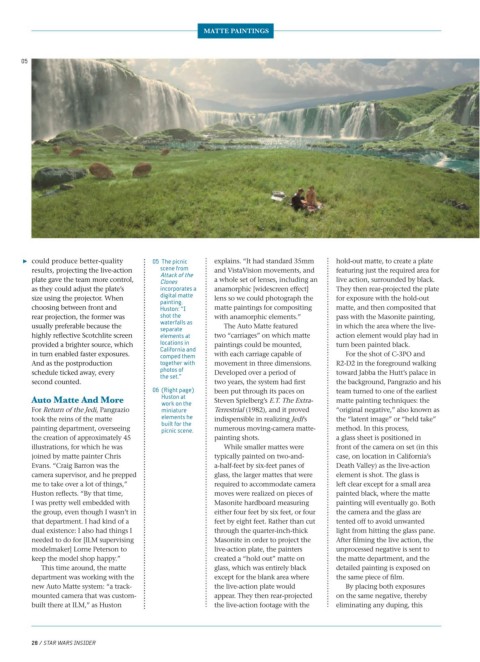
           could produce better-quality           05  The picnic      explains. “It had standard 35mm        hold-out matte, to create a plate

           results, projecting the live-action       scene from       and VistaVision movements, and         featuring just the required area for
                                                     Attack of the
           plate gave the team more control,         Clones           a whole set of lenses, including an    live action, surrounded by black.
           as they could adjust the plate’s          incorporates a   anamorphic [widescreen effect]         They then rear-projected the plate
                                                     digital matte
           size using the projector. When                             lens so we could photograph the        for exposure with the hold-out
                                                     painting.
           choosing between front and                Huston: “I       matte paintings for compositing        matte, and then composited that
           rear projection, the former was           shot the         with anamorphic elements.”             pass with the Masonite painting,
                                                     waterfalls as
           usually preferable because the                                The Auto Matte featured             in which the area where the live-
                                                     separate

           highly reflective Scotchlite screen        elements at      two “carriages” on which matte         action element would play had in
           provided a brighter source, which         locations in     paintings could be mounted,            turn been painted black.
                                                     California and
           in turn enabled faster exposures.         comped them      with each carriage capable of             For the shot of C-3PO and
           And as the postproduction                 together with    movement in three dimensions.          R2-D2 in the foreground walking
                                                     photos of
           schedule ticked away, every                                Developed over a period of             toward Jabba the Hutt’s palace in
                                                     the set.”
           second counted.                                            two years, the system had first         the background, Pangrazio and his

                                                  06   (Right page)   been put through its paces on          team turned to one of the earliest

           Auto Matte And More                       Huston at        Steven Spielberg’s E.T. The Extra-     matte painting techniques: the
                                                     work on the
           For Return of the Jedi, Pangrazio         miniature        Terrestrial (1982), and it proved      “original negative,” also known as
           took the reins of the matte               elements he      indispensible in realizing Jedi’s      the “latent image” or “held take”
                                                     built for the
           painting department, overseeing                            numerous moving-camera matte-          method. In this process,
                                                     picnic scene.
           the creation of approximately 45                           painting shots.                        a glass sheet is positioned in
           illustrations, for which he was                               While smaller mattes were           front of the camera on set (in this
           joined by matte painter Chris                              typically painted on two-and-          case, on location in California’s
           Evans. “Craig Barron was the                               a-half-feet by six-feet panes of       Death Valley) as the live-action
           camera supervisor, and he prepped                          glass, the larger mattes that were     element is shot. The glass is
           me to take over a lot of things,”                          required to accommodate camera         left clear except for a small area
           Huston reflects. “By that time,                             moves were realized on pieces of       painted black, where the matte

           I was pretty well embedded with                            Masonite hardboard measuring           painting will eventually go. Both
           the group, even though I wasn’t in                         either four feet by six feet, or four   the camera and the glass are
           that department. I had kind of a                           feet by eight feet. Rather than cut    tented off to avoid unwanted
           dual existence: I also had things I                        through the quarter-inch-thick         light from hitting the glass pane.
           needed to do for [ILM supervising                          Masonite in order to project the       After filming the live action, the

           modelmaker] Lorne Peterson to                              live-action plate, the painters        unprocessed negative is sent to
           keep the model shop happy.”                                created a “hold out” matte on          the matte department, and the
              This time around, the matte                             glass, which was entirely black        detailed painting is exposed on

           department was working with the                            except for the blank area where        the same piece of film.
           new Auto Matte system: “a track-                           the live-action plate would               By placing both exposures
           mounted camera that was custom-                            appear. They then rear-projected       on the same negative, thereby
           built there at ILM,” as Huston                             the live-action footage with the       eliminating any duping, this


           28 / STAR WARS INSIDER

