


Page 24 - All About History - Issue 26-15
P. 24
Animals & Man


         Day in the life


        AWILDWESTCOWBOY


         RISKING LIFE AND LIMB TO DELIVER

         CATTLE TO MARKET, UNITED STATES

         OF AMERICA, 19TH CENTURY


             The classic image of the cowboy clad in ten-gallon hat and slacks is
             one that has been heavily romanticised in folklore, film and television.
             Although cowboys are now viewed as all-American heroes, their
             roots can be traced to Medieval Spain. Spanish traditions of cattle
             ranching spread to the vaquero of northern Mexico, where the
             Mexican cowboys, or ‘Mustang-runners’, broke and rode horses to
             markets. Eventually these traditions merged with the English-
             speaking traders to form what is now commonly regarded
             as the ‘cowboy’. Although the classic days of the cowboys
             were cut short by the emergence of barbed wire
             fences, they created a culture so strong that it
             still attracts great fascination today.
                WAKE UP


                Every minute counted in a cowboy’s
                demanding day, so they would wake and
                dress before sunrise after only a few hours
                of disturbed sleep. The cowboy uniform
                was not a fashion statement – every piece
                served a purpose, from the hat that shielded
                the wearer from the sun to the bandana that
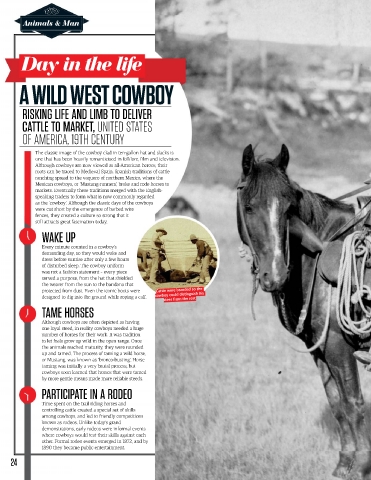
                protected from dust. Even the iconic boots were  Cattle were branded so the
                designed to dig into the ground while roping a calf.  cowboy could distinguish his
                                                           steer from the rest
                TAME HORSES

                Although cowboys are often depicted as having
                one loyal steed, in reality cowboys needed a huge
                number of horses for their work. It was tradition
                to let foals grow up wild in the open range. Once
                the animals reached maturity, they were rounded
                up and tamed. The process of taming a wild horse,
                or Mustang, was known as ‘bronco-busting’. Horse
                taming was initially a very brutal process, but
                cowboys soon learned that horses that were tamed
                by more gentle means made more reliable steeds.

                PARTICIPATE IN A RODEO

                Time spent on the trail riding horses and
                controlling cattle created a special set of skills
                among cowboys, and led to friendly competitions
                known as rodeos. Unlike today’s grand
                demonstrations, early rodeos were informal events
                where cowboys would test their skills against each
                other. Formal rodeo events emerged in 1872, and by
                1890 they became public entertainment.
     24

