


Page 28 - Aviation News (February 2020)
P. 28
Tales of the  Trislander


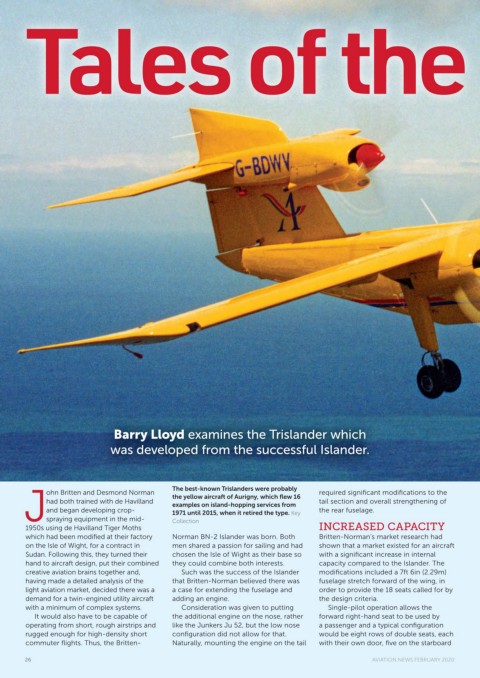
                                 Barry Lloyd examines the Trislander which
                                 was developed from the successful Islander.


                                                The best-known Trislanders were probably
                 ohn Britten and Desmond Norman                                     required signifi cant modifi cations to the
                 had both trained with de Havilland   the yellow aircraft of Aurigny, which fl ew 16   tail section and overall strengthening of
                                                examples on island-hopping services from
                 and began developing crop-     1971 until 2015, when it retired the type. Key   the rear fuselage.
           J spraying equipment in the mid-     Collection
           1950s using de Havilland Tiger Moths                                     INCREASED CAPACITY
           which had been modifi ed at their factory   Norman BN-2 Islander was born. Both   Britten-Norman’s market research had
           on the Isle of Wight, for a contract in   men shared a passion for sailing and had   shown that a market existed for an aircraft
           Sudan. Following this, they turned their   chosen the Isle of Wight as their base so   with a signifi cant increase in internal
           hand to aircraft design, put their combined   they could combine both interests.   capacity compared to the Islander. The
           creative aviation brains together and,   Such was the success of the Islander   modifi cations included a 7ft 6in (2.29m)
           having made a detailed analysis of the   that Britten-Norman believed there was   fuselage stretch forward of the wing, in
           light aviation market, decided there was a   a case for extending the fuselage and   order to provide the 18 seats called for by
           demand for a twin-engined utility aircraft   adding an engine.           the design criteria.
           with a minimum of complex systems.     Consideration was given to putting   Single-pilot operation allows the
              It would also have to be capable of   the additional engine on the nose, rather   forward right-hand seat to be used by
           operating from short, rough airstrips and   like the Junkers Ju 52, but the low nose   a passenger and a typical confi guration
           rugged enough for high-density short   confi guration did not allow for that.   would be eight rows of double seats, each
           commuter fl ights. Thus, the Britten-    Naturally, mounting the engine on the tail   with their own door, fi ve on the starboard

           26                                                                                     AVIATION NEWS FEBRUARY 2020


       26-30_trislanderDC.mfDC.mf.indd   26                                                                      13/01/2020   14:49

