


Page 83 - Aviation News (February 2020)
P. 83
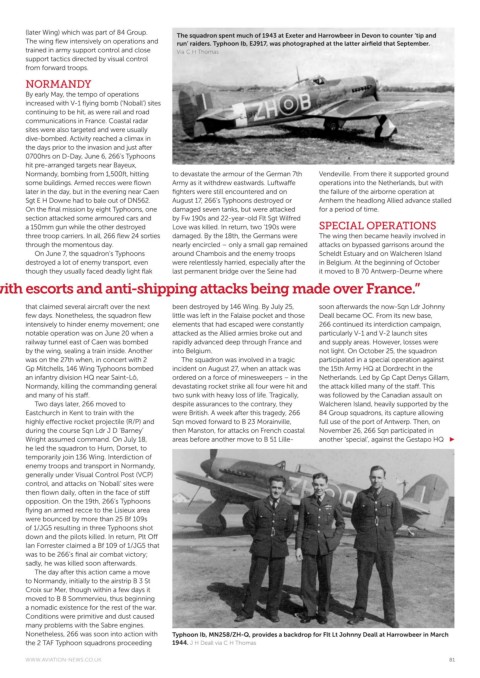
(later Wing) which was part of 84 Group.   The squadron spent much of 1943 at Exeter and Harrowbeer in Devon to counter ‘tip and
           The wing flew intensively on operations and   run’ raiders. Typhoon Ib, EJ917, was photographed at the latter airfield that September.
           trained in army support control and close   Via C H Thomas
           support tactics directed by visual control
           from forward troops.

           NORMANDY
           By early May, the tempo of operations
           increased with V-1 flying bomb (‘Noball’) sites
           continuing to be hit, as were rail and road
           communications in France. Coastal radar
           sites were also targeted and were usually
           dive-bombed. Activity reached a climax in
           the days prior to the invasion and just after
           0700hrs on D-Day, June 6, 266’s Typhoons
           hit pre-arranged targets near Bayeux,
           Normandy, bombing from 1,500ft, hitting   to devastate the armour of the German 7th   Vendeville. From there it supported ground
           some buildings. Armed recces were flown   Army as it withdrew eastwards. Luftwaffe   operations into the Netherlands, but with
           later in the day, but in the evening near Caen   fighters were still encountered and on   the failure of the airborne operation at
           Sgt E H Downe had to bale out of DN562.   August 17, 266’s Typhoons destroyed or   Arnhem the headlong Allied advance stalled
           On the final mission by eight Typhoons, one   damaged seven tanks, but were attacked   for a period of time.
           section attacked some armoured cars and   by Fw 190s and 22-year-old Flt Sgt Wilfred
           a 150mm gun while the other destroyed   Love was killed. In return, two ’190s were   SPECIAL OPERATIONS
           three troop carriers. In all, 266 flew 24 sorties   damaged. By the 18th, the Germans were   The wing then became heavily involved in
           through the momentous day.           nearly encircled – only a small gap remained   attacks on bypassed garrisons around the
              On June 7, the squadron’s Typhoons   around Chambois and the enemy troops   Scheldt Estuary and on Walcheren Island
           destroyed a lot of enemy transport, even   were relentlessly harried, especially after the   in Belgium. At the beginning of October
           though they usually faced deadly light flak   last permanent bridge over the Seine had   it moved to B 70 Antwerp-Deurne where
 “The pace of operations quickened in the first months of 1944 with escorts and anti-shipping attacks being made over France.”


           that claimed several aircraft over the next   been destroyed by 146 Wing. By July 25,   soon afterwards the now-Sqn Ldr Johnny
           few days. Nonetheless, the squadron flew   little was left in the Falaise pocket and those   Deall became OC. From its new base,
           intensively to hinder enemy movement; one   elements that had escaped were constantly   266 continued its interdiction campaign,
           notable operation was on June 20 when a   attacked as the Allied armies broke out and   particularly V-1 and V-2 launch sites
           railway tunnel east of Caen was bombed   rapidly advanced deep through France and   and supply areas. However, losses were
           by the wing, sealing a train inside. Another   into Belgium.             not light. On October 25, the squadron
           was on the 27th when, in concert with 2   The squadron was involved in a tragic   participated in a special operation against
           Gp Mitchells, 146 Wing Typhoons bombed   incident on August 27, when an attack was   the 15th Army HQ at Dordrecht in the
           an infantry division HQ near Saint-Lô,   ordered on a force of minesweepers – in the   Netherlands. Led by Gp Capt Denys Gillam,
           Normandy, killing the commanding general   devastating rocket strike all four were hit and   the attack killed many of the staff. This
           and many of his staff.               two sunk with heavy loss of life. Tragically,   was followed by the Canadian assault on
              Two days later, 266 moved to      despite assurances to the contrary, they   Walcheren Island, heavily supported by the
           Eastchurch in Kent to train with the   were British. A week after this tragedy, 266   84 Group squadrons, its capture allowing
           highly effective rocket projectile (R/P) and   Sqn moved forward to B 23 Morainville,   full use of the port of Antwerp. Then, on
           during the course Sqn Ldr J D ‘Barney’   then Manston, for attacks on French coastal   November 26, 266 Sqn participated in
           Wright assumed command. On July 18,   areas before another move to B 51 Lille-  another ‘special’, against the Gestapo HQ
           he led the squadron to Hurn, Dorset, to
           temporarily join 136 Wing. Interdiction of
           enemy troops and transport in Normandy,
           generally under Visual Control Post (VCP)
           control, and attacks on ‘Noball’ sites were
           then flown daily, often in the face of stiff
           opposition. On the 19th, 266’s Typhoons
           flying an armed recce to the Lisieux area
           were bounced by more than 25 Bf 109s
           of 1/JG5 resulting in three Typhoons shot
           down and the pilots killed. In return, Plt Off
           Ian Forrester claimed a Bf 109 of 1/JG5 that
           was to be 266’s final air combat victory;
           sadly, he was killed soon afterwards.
              The day after this action came a move
           to Normandy, initially to the airstrip B 3 St
           Croix sur Mer, though within a few days it
           moved to B 8 Sommervieu, thus beginning
           a nomadic existence for the rest of the war.
           Conditions were primitive and dust caused
           many problems with the Sabre engines.
           Nonetheless, 266 was soon into action with   Typhoon Ib, MN258/ZH-Q, provides a backdrop for Flt Lt Johnny Deall at Harrowbeer in March
           the 2 TAF Typhoon squadrons proceeding   1944. J H Deall via C H Thomas

           WWW.AVIATION-NEWS.CO.UK                                                                                   81


       79-82_266_squadronDC.mfDC.mf.indd   81                                                                    03/01/2020   16:42

