


Page 236 - (DK Eyewitness) Travel Guide - Portugal
P. 236
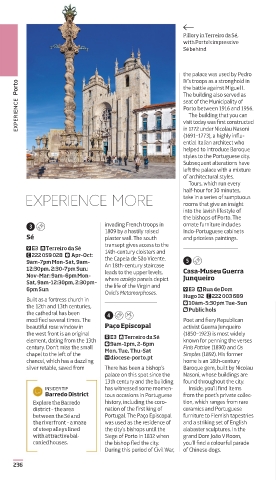
Pillory in Terreiro da Sé,
with Porto’s impressive
Sé behind
the palace was used by Pedro
IV’s troops as a stronghold in
EXPERIENCE Porto The building also served as
the battle against Miguel I.
seat of the Municipality of
Porto between 1916 and 1956.
The building that you can
visit today was first constructed
in 1772 under Nicolau Nasoni
(1691–1773), a highly influ-
ential Italian architect who
helped to introduce Baroque
styles to the Portuguese city.
Subsequent alterations have
left the palace with a mixture
of architectural styles.
Tours, which run every
half-hour for 30 minutes,
EXPERIENCE MORE take in a series of sumptuous
rooms that give an insight
into the lavish life style of
the bishops of Porto. The
invading French troops in ornate furniture includes
3 " 1809 by a hastily raised Indo-Portuguese cabinets
Sé plaster wall. The south and priceless paintings.
transept gives access to the
E3 ⌂ Terreiro da Sé
§ 222 059 028 # Apr–Oct: 14th-century cloisters and
9am–7pm Mon–Sat, 9am– the Capela de São Vicente. 5 "
12:30pm, 2:30–7pm Sun; An 18th-century stair case Casa-Museu Guerra
leads to the upper levels,
Nov–Mar: 9am–6pm Mon– Junqueiro
Sat, 9am–12:30pm, 2:30pm– where azulejo panels depict
6pm Sun the life of the Virgin and E3 ⌂ Rua de Dom
Ovid’s Metamorphoses.
Built as a fortress church in Hugo 32 § 222 003 689
# 10am–5:30pm Tue–Sun
the 12th and 13th centuries, ¢ Public hols
the cathedral has been
modified several times. The 4 "' Poet and fiery Republican
beautiful rose window in Paço Episcopal activist Guerra Junqueiro
the west front is an original E3 ⌂ Terreiro da Sé (1850 –1923) is most widely
element, dating from the 13th # 9am–1pm, 2–6pm known for penning the verses
century. Don't miss the small Mon, Tue, Thu–Sat Finis Patriae (1890) and Os
chapel to the left of the ∑ diocese-porto.pt Simples (1892). His former
chancel, which has a dazzling home is an 18th-century
silver retable, saved from There has been a bishop’s Baroque gem, built by Nicolau
palace on this spot since the Nasoni, whose buildings are
13th century and the building found throughout the city.
INSIDER TIP has witnessed some momen- Inside, you'll find items
Barredo District tous occasions in Portuguese from the poet’s private collec-
Explore the Barredo history, including the coro- tion, which ranges from rare
district – the area nation of the first king of ceramics and Portuguese
between the Sé and Portugal. The Paço Episcopal furniture to Flemish tapestries
the riverfront – a maze was used as the residence of and a striking set of English
of steep alleys lined the city’s bishops until the ala baster sculptures. In the
with attractive bal Siege of Porto in 1832 when grand Dom João V Room,
conied houses. the bishop fled the city. you'll find a colourful parade
During this period of Civil War, of Chinese dogs.
236
236-237_EW_Portugal.indd 236 20/09/2018 10:41
EW Catalogue template v3.0 – 12th July 2018
Fonts: Aptifer Sans LT Pro, Posterama Text, Soho Gothic
Pro, Soho Pro, ITC Caslon 224

