


Page 245 - (DK Eyewitness) Travel Guide - Portugal
P. 245
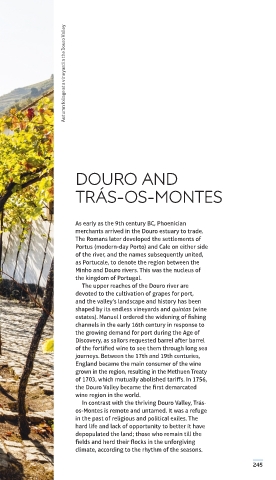
Autumn foliage at a vineyard in the Douro Valley


                    DOURO AND

                    TRÁS-OS-MONTES


                    As early as the 9th century BC, Phoenician
                    merchants arrived in the Douro estuary to trade.
                    The Romans later developed the settlements of
                    Portus (modern-day Porto) and Cale on either side
                    of the river, and the names subsequently united,
                    as Portucale, to denote the region between the
                    Minho and Douro rivers. This was the nucleus of
                    the kingdom of Portugal.
                      The upper reaches of the Douro river are
                    devoted to the cultivation of grapes for port,
                    and the valley’s landscape and history has been
                    shaped by its endless vineyards and quintas (wine
                    estates). Manuel I ordered the widening of fishing
                    channels in the early 16th century in response to
                    the growing demand for port during the Age of
                    Discovery, as sailors requested barrel after barrel
                    of the fortified wine to see them through long sea
                    journeys. Between the 17th and 19th centuries,
                    England became the main consumer of the wine
                    grown in the region, resulting in the Methuen Treaty
                    of 1703, which mutually abolished tariffs. In 1756,
                    the Douro Valley became the first demarcated
                    wine region in the world.
                      In contrast with the thriving Douro Valley, Trás-
                    os-Montes is remote and untamed. It was a refuge
                    in the past of religious and political exiles. The
                    hard life and lack of opportunity to better it have
                    depopul ated the land; those who remain till the
                    fields and herd their flocks in the unforgiving
                    climate, according to the rhythm of the seasons.
                                                                  245


   244-245_EW_Portugal.indd   245                            20/09/2018   10:41

