


Page 293 - (DK Eyewitness) Travel Guide - Portugal
P. 293
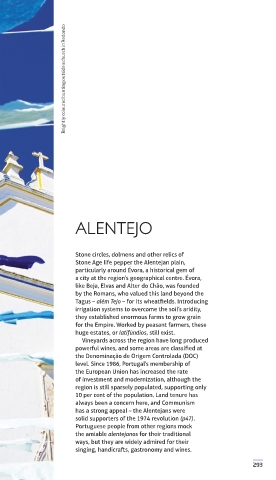
Brightly coloured bunting outside a church in Redondo


                    ALENTEJO


                    Stone circles, dolmens and other relics of
                    Stone Age life pepper the Alentejan plain,
                    particularly around Évora, a historical gem of
                    a city at the region’s geographical centre. Évora,
                    like Beja, Elvas and Alter do Chão, was founded
                    by the Romans, who valued this land beyond the
                    Tagus – além Tejo – for its wheatfields. Introducing
                    irrigation systems to overcome the soil’s aridity,
                    they established enormous farms to grow grain
                    for the Empire. Worked by peasant farmers, these
                    huge estates, or latifúndios, still exist.
                      Vineyards across the region have long produced
                    powerful wines, and some areas are classified at
                    the Denominação de Origem Controlada (DOC)
                    level. Since 1986, Portugal’s membership of
                    the European Union has increased the rate
                    of investment and modernization, although the
                    region is still sparsely populated, supporting only
                    10 per cent of the population. Land tenure has
                    always been a concern here, and Communism
                    has a strong appeal – the Alentejans were
                    solid supporters of the 1974 revolution (p47).
                    Portuguese people from other regions mock
                    the amiable alentejanos for their traditional
                    ways, but they are widely admired for their
                    singing, handicrafts, gastronomy and wines.
                                                                  293


   292-293_EW_Portugal.indd   293                            20/09/2018   10:42

