


Page 299 - (DK Eyewitness) Travel Guide - Portugal
P. 299
Must See
       6                   follow a well-signposted trail
                           for 8.3 km (5 miles) along
       Largo da Porta      a surviving 9-km- (6-mile-)
       de Moura            long stretch.             EAT
       The western entrance to this
       square is guarded by the   9                   Fialho
       vestiges of a Moorish gateway.              A historic, award-
       Both the domed Casa Soure   Walls          winning restaurant
       and the double arches of the                 specializing in
       belvedere on Casa Cordovil at   The fortifications that have   recreating traditional
       the opposite end, show the   protected Évora down the   recipes, with a good
       Arab influence on architecture   centuries form two incomplete   wine list. Book
       in Évora. The central fountain,   concentric circles. The inner   in advance.
       looking like some futur istic orb,   ring, of which only fragments    ⌂ Travessa das
       surprisingly dates back to 1556.  are discernible, is Roman,   Mascarenhas 16, Évora
                           from perhaps as early as the   § 266 703 079   ¢ Mon
                           1st century AD, with Moorish   ¡¡¡
       7                   and medieval additions – the
                           two stubby towers that give
       Fundação Eugénio    the Largo da Porta de Moura   Momentos
       de Almeida          its name mark an Arab gate.  The chef guides you
                             In the 14th century, new   through the menu of
       ⌂ Páteo de São Miguel                      the day here, which
       # Tue–Sun   ¢ Public hols  walls were built to encompass   features local organic
                           the growing town. Completed
       This avant-garde modern   under Fernando I, these had   produce. Unlike much
       exhibition space plays host to   40 towers and 10 gates,   Portuguese cuisine, the
                                                  fish and meat dishes
       local and national artists and   including the Porta de   are accompanied by
       the occasional inter national   Alconchel, which still    beautifully presented
       name, such as Marcel   faces the Lisbon road.  salads or vegetables
       Duchamp. It also promotes     When João IV was defiantly   rather than chips.
       the performing arts, staging   declared king in 1640 (p45),
       regular concerts and reci tals.   major fortifications were   ⌂ Rua 5 de Outubro 61B,
                                                  Évora   § 925 161 423
       The building provides access   erected in anticipation of   ¢ Mon & Wed–Fri L, Tue
       to the Carriage Museum, and   Spanish attack, and it is these
       tours to the nearby Cartuxa   17th-century walls which are   ¡¡¡
       winery can be booked here.  most evident today. The walls
                           withstood much battering from
                           the besieging Spanish in 1663.
       8
       Aqueduto da
       Água de Prata
       Évora’s aqueduct was built
       between 1531 and 1537 by the
       town’s own eminent architect,
       Francisco de Arruda. The
       construction was regarded
       with wonder, and is even des-
       cribed in Os Lusíadas, the epic
       by Luís de Camões (p184). It
       originally carried water as far
       as the Praça do Giraldo. It was
       damaged in the 17th century
       during the Restoration War
       with Spain, but visitors can


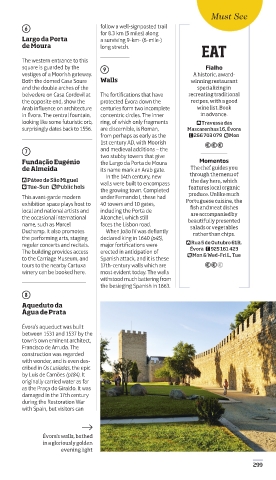
            Évora’s walls, bathed
            in a gloriously golden
                 evening light
                                                                  299


   298-299_EW_Portugal.indd   299                            20/09/2018   10:42

