


Page 28 - Guest Service Directory
P. 28
Inf                                                                   Inf


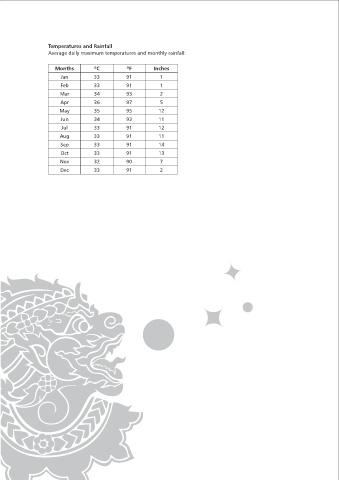
 Krabi Province:  Temperatures and Rainfall
 is located 814 kms. From Bangkok along Highway No.4 via Phetchahuri, Prachuap Kiri Khan, Chumphon,   Average daily maximum temperatures and monthly rainfall:
 Ranong and Phangnga. Five kilometers before the town, the highway runs parallel to Krabi River featuring
 the very beautiful scenery of a river flowing between two mountain ranges.  Months    ºC    ºF    Inches
                      Jan         33         91          1
 Krabi is located on the coastline of the Indian Ocean bordering Amphuer Phra Saeng of Surat Thani and Tap
 Put of Phangnga to the north, Trang and the Andaman Sea to the south, Nakhon Si Thammarat and Trang to   Feb  33    91    1
 the east, Phangnga and the Andaman Sea to the west.  Mar  34     93    2
                      Apr         36         97          5
 It occupies an area of 4,708 square kilometers, administratively divided into 8 Amphuers or districts: Muang,   May  35   95   12
 Ao Luk, Khao Phamom, Khlong Thorm, Ko Lanta, Plai Phraya, Lam Thap and Nua Khlong.
                      Jun         34         93          11

 The general geographic condition consists of mountains, hills, plains and more than 130 small islands off the   Jul  33   91   12
 coast. The still pristine jungles Include white mangrove and mangrove forests. The soil is mostly sandy Clay   Aug  33    91    11
 and rich loam, perfect for rubber, palm, cashew nut, coffee and Coconut plantations.
                      Sep         33         91          14
                      Oct         33         91          13
 Local Surroundings:
 Phi Phi Island, approximately 1 hour by speed boat (swimming and snorkeling)  Nov  32     90     7
 Pranang Cave, approximately 10 minutes by speed boat (sight seeing)  Dec  33    91    2
 Porda Island, approximately 15 minutes by speed boat (swimming, snorkeling & sunbathing)
 Chicken Island, approximately 20 minutes by speed boat (swimming and snorkeling)
 Krabi Town, approximately 25 minutes by bus (shopping, sight seeing)
 Huiyto Waterfall, approximately 1 hour drive (sight seeing)
 Hot Spring & Crystal Pool approximately 1.5 hours drive (swimming and sight seeing)


 Beach/Public & Long Tail boats:
 All beaches in the area are public; therefore please respect the local culture as any form of nudity is not
 accepted. Beach conditions can fluctuate from time to time in the year with variances in sea and tide
 conditions. Please follow the advice of the marine department’s daily weather and sea conditions for both
 swimming and water sports. Please be aware that the long tail boat operators are just that and if you
 choose to use their services please be aware of varying charges which can change dramatically all the time.

 Jellyfish:
 Beware of the Fire Jelly Fish on the high tides from August to October. If stung an uncomfortable burning
 sensation will be felt but it is not fatal. Please seek first aid treatment as soon as practical.

 Climate:
 Thailand has a tropical climate with three seasons:

 Rainy Season:
 Beware of the Fire Jelly Fish on the high tides from August to October. If stung an uncomfortable burning
 sensation will be felt but it is not fatal. Please seek first aid treatment as soon as practical.

 Cool Season:
 The northeast monsoon comes from Central Asia and usually blows from November to February, bringing
 relatively cool, dry conditions to the country.

 Hot Season:
 Between the 2 monsoons, March to May, the land heats up creating an area of low pressure. Eventually the
 high pressure over the Indian Ocean moves inland and the monsoon cycle begins again. The word monsoon
 comes from the Arabic maws in or season. It refers to South Asia’s seasonal winds (not the heavy rains).
 In Thailand, the southwest monsoon is the rainy season; the northeast monsoon is dry or cool season.
 Temperature change is rather minor between the seasons.

