


Page 32 - REC :: M.E. CS Curriculum and Syllabus - R2019
P. 32
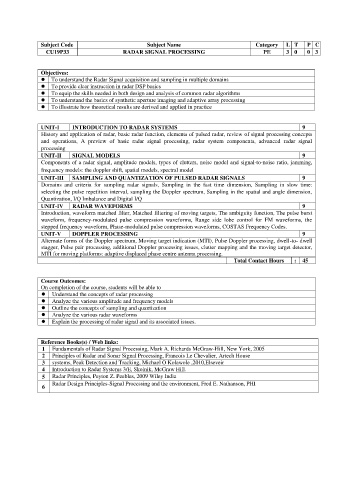
Subject Code Subject Name Category L T P C
CU19P33 RADAR SIGNAL PROCESSING PE 3 0 0 3
Objectives:
To understand the Radar Signal acquisition and sampling in multiple domains
To provide clear instruction in radar DSP basics
To equip the skills needed in both design and analysis of common radar algorithms
To understand the basics of synthetic aperture imaging and adaptive array processing
To illustrate how theoretical results are derived and applied in practice
UNIT-I INTRODUCTION TO RADAR SYSTEMS 9
History and application of radar, basic radar function, elements of pulsed radar, review of signal processing concepts
and operations, A preview of basic radar signal processing, radar system components, advanced radar signal
processing
UNIT-II SIGNAL MODELS 9
Components of a radar signal, amplitude models, types of clutters, noise model and signal-to-noise ratio, jamming,
frequency models: the doppler shift, spatial models, spectral model
UNIT-III SAMPLING AND QUANTIZATION OF PULSED RADAR SIGNALS 9
Domains and criteria for sampling radar signals, Sampling in the fast time dimension, Sampling in slow time:
selecting the pulse repetition interval, sampling the Doppler spectrum, Sampling in the spatial and angle dimension,
Quantization, I/Q Imbalance and Digital I/Q
UNIT-IV RADAR WAVEFORMS 9
Introduction, waveform matched filter, Matched filtering of moving targets, The ambiguity function, The pulse burst
waveform, frequency-modulated pulse compression waveforms, Range side lobe control for FM waveforms, the
stepped frequency waveform, Phase-modulated pulse compression waveforms, COSTAS Frequency Codes.
UNIT-V DOPPLER PROCESSING 9
Alternate forms of the Doppler spectrum, Moving target indication (MTI), Pulse Doppler processing, dwell-to- dwell
stagger, Pulse pair processing, additional Doppler processing issues, clutter mapping and the moving target detector,
MTI for moving platforms: adaptive displaced phase centre antenna processing.
Total Contact Hours : 45
Course Outcomes:
On completion of the course, students will be able to
Understand the concepts of radar processing
Analyze the various amplitude and frequency models
Outline the concepts of sampling and quantization
Analyze the various radar waveforms
Explain the processing of radar signal and its associated issues.
Reference Books(s) / Web links:
1 Fundamentals of Radar Signal Processing, Mark A. Richards McGraw-Hill, New York, 2005
2 Principles of Radar and Sonar Signal Processing, Francois Le Chevalier, Artech House
3 systems, Peak Detection and Tracking, Michael O Kolawole ,2010,Elseveir
4 Introduction to Radar Systems 3/E, Skolnik, McGraw Hill.
5 Radar Principles, Peyton Z. Peebles, 2009 Wiley India
Radar Design Principles-Signal Processing and the environment, Fred E. Nathanson, PHI
6

