


Page 9 - REC :: M.E. EST Curriculum and Syllabus - R2019
P. 9
M.E Embedded System Technologies
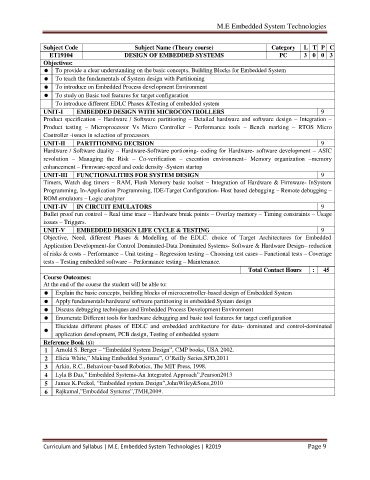
Subject Code Subject Name (Theory course) Category L T P C
ET19104 DESIGN OF EMBEDDED SYSTEMS PC 3 0 0 3
Objectives:
To provide a clear understanding on the basic concepts, Building Blocks for Embedded System
To teach the fundamentals of System design with Partitioning
To introduce on Embedded Process development Environment
To study on Basic tool features for target configuration
To introduce different EDLC Phases &Testing of embedded system
UNIT-I EMBEDDED DESIGN WITH MICROCONTROLLERS 9
Product specification – Hardware / Software partitioning – Detailed hardware and software design – Integration –
Product testing – Microprocessor Vs Micro Controller – Performance tools – Bench marking – RTOS Micro
Controller -issues in selection of processors
UNIT-II PARTITIONING DECISION 9
Hardware / Software duality – Hardware-Software portioning- coding for Hardware- software development – ASIC
revolution – Managing the Risk – Co-verification – execution environment– Memory organization –memory
enhancement – Firmware-speed and code density -System startup
UNIT-III FUNCTIONALITIES FOR SYSTEM DESIGN 9
Timers, Watch dog timers – RAM, Flash Memory basic toolset – Integration of Hardware & Firmware- InSystem
Programming, In-Application Programming, IDE-Target Configuration- Host based debugging – Remote debugging –
ROM emulators – Logic analyzer
UNIT-IV IN CIRCUIT EMULATORS 9
Bullet proof run control – Real time trace – Hardware break points – Overlay memory – Timing constraints – Usage
issues – Triggers.
UNIT-V EMBEDDED DESIGN LIFE CYCLE & TESTING 9
Objective, Need, different Phases & Modelling of the EDLC. choice of Target Architectures for Embedded
Application Development-for Control Dominated-Data Dominated Systems- Software & Hardware Design– reduction
of risks & costs – Performance – Unit testing – Regression testing – Choosing test cases – Functional tests – Coverage
tests – Testing embedded software – Performance testing – Maintenance.
Total Contact Hours : 45
Course Outcomes:
At the end of the course the student will be able to:
Explain the basic concepts, building blocks of microcontroller-based design of Embedded System
Apply fundamentals hardware/ software partitioning in embedded System design
Discuss debugging techniques and Embedded Process Development Environment
Enumerate Different tools for hardware debugging and basic tool features for target configuration
Elucidate different phases of EDLC and embedded architecture for data- dominated and control-dominated
application development, PCB design, Testing of embedded system
Reference Book (s):
1 Arnold S. Berger – “Embedded System Design”, CMP books, USA 2002.
2 Elicia White,” Making Embedded Systems”, O’Reilly Series,SPD,2011
3 Arkin, R.C., Behaviour-based Robotics, The MIT Press, 1998.
4 Lyla B Das,” Embedded Systems-An Integrated Approach”,Pearson2013
5 James K.Peckol, “Embedded system Design”,JohnWiley&Sons,2010
6 Rajkamal,”Embedded Systems”,TMH,2009.
Curriculum and Syllabus | M.E. Embedded System Technologies | R2019 Page 9

