


Page 102 - REC :: All Dept Open Electives
P. 102
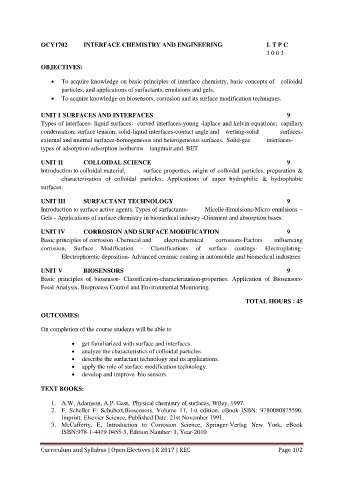
OCY1702 INTERFACE CHEMISTRY AND ENGINEERING L T P C
3 0 0 3
OBJECTIVES:
To acquire knowledge on basic principles of interface chemistry, basic concepts of colloidal
particles, and applications of surfactants, emulsions and gels.
To acquire knowledge on biosensors, corrosion and its surface modification techniques.
UNIT I SURFACES AND INTERFACES 9
Types of interfaces- liquid surfaces- curved interfaces-young -laplace and kelvin equations; capillary
condensation; surface tension; solid-liquid interfaces-contact angle and wetting-solid surfaces-
external and internal surfaces-homogeneous and heterogeneous surfaces. Solid-gas interfaces-
types of adsorption-adsorption isotherms – langmuir,and BET.
UNIT II COLLOIDAL SCIENCE 9
Introduction to colloidal material, surface properties, origin of colloidal particles, preparation &
characterization of colloidal particles. Applications of super hydrophilic & hydrophobic
surfaces.
UNIT III SURFACTANT TECHNOLOGY 9
Introduction to surface active agents. Types of surfactants- Micelle-Emulsions-Micro emulsions –
Gels - Applications of surface chemistry in biomedical industry -Ointment and absorption bases.
UNIT IV CORROSION AND SURFACE MODIFICATION 9
Basic principles of corrosion -Chemical and electrochemical corrosions-Factors influencing
corrosion, Surface Modification - Classifications of surface coatings- Electroplating-
Electrophoretic deposition- Advanced ceramic coating in automobile and biomedical industries
UNIT V BIOSENSORS 9
Basic principles of biosensor- Classification-characterization-properties. Application of Biosensors-
Food Analysis, Bioprocess Control and Environmental Monitoring.
TOTAL HOURS : 45
OUTCOMES:
On completion of the course students will be able to
get familiarized with surface and interfaces.
analyze the characteristics of colloidal particles.
describe the surfactant technology and its applications.
apply the role of surface modification technology.
develop and improve bio sensors.
TEXT BOOKS:
1. A.W. Adamson, A.P. Gast, Physical chemistry of surfaces, Wiley, 1997.
2. F. Scheller F. Schubert,Biosensors, Volume 11, 1st edition. eBook ISBN: 9780080875590,
Imprint: Elsevier Science, Published Date: 21st November 1991.
3. McCafferty, E, Introduction to Corrosion Science, Springer-Verlag New York, eBook
ISBN:978-1-4419-0455-3, Edition Number: 1, Year-2010
Curriculum and Syllabus | Open Electives | R 2017 | REC Page 102

