


Page 47 - REC :: M.E. CSE Curriculum and Syllabus - R2019
P. 47
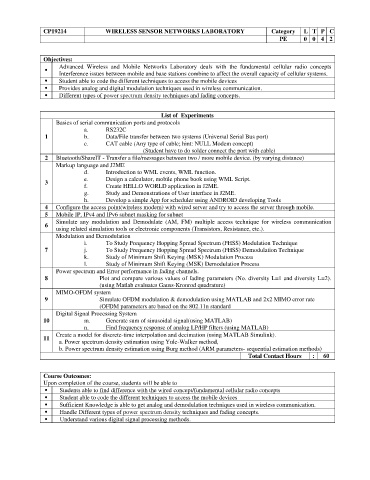
CP19214              WIRELESS SENSOR NETWORKS LABORATORY                    Category   L  T  P  C
                                                                                              PE      0  0  4  2


               Objectives:
                     Advanced  Wireless  and  Mobile  Networks  Laboratory  deals  with  the  fundamental  cellular  radio  concepts
                ⚫
                     Interference issues between mobile and base stations combine to affect the overall capacity of cellular systems.
                     Student able to code the different techniques to access the mobile devices
                ⚫
                     Provides analog and digital modulation techniques used in wireless communication.
                ⚫
                     Different types of power spectrum density techniques and fading concepts.
                ⚫

                                                      List of  Experiments
                    Basics of serial communication ports and protocols
                             a.     RS232C
                1            b.     Data/File transfer between two systems (Universal Serial Bus port)
                             c.     CAT cable (Any type of cable; hint: NULL Modem concept)
                                                (Student have to do solder connect the port with cable)
                2   Bluetooth/ShareIT - Transfer a file/messages between two / more mobile device. (by varying distance)
                    Markup language and J2ME
                             d.     Introduction to WML events, WML function.
                             e.     Design a calculator, mobile phone book using WML Script.
                3
                             f.     Create HELLO WORLD application in J2ME.
                             g.     Study and Demonstrations of User interface in J2ME.
                             h.     Develop a simple App for scheduler using ANDROID developing Tools
                4   Configure the access point(wireless modem) with wired server and try to access the server through mobile.
                5   Mobile IP, IPv4 and IPv6 subnet masking for subnet
                    Simulate  any  modulation  and  Demodulate  (AM,  FM)  multiple  access  technique  for  wireless  communication
                6
                    using related simulation tools or electronic components (Transistors, Resistance, etc.).
                    Modulation and Demodulation
                             i.     To Study Frequency Hopping Spread Spectrum (FHSS) Modulation Technique
                7            j.     To Study Frequency Hopping Spread Spectrum (FHSS) Demodulation Technique
                             k.     Study of Minimum Shift Keying (MSK) Modulation Process
                             l.     Study of Minimum Shift Keying (MSK) Demodulation Process
                    Power spectrum and Error performance in fading channels.
                8                 Plot and compare various values of fading parameters (No. diversity L=1 and diversity L=2).
                                  (using Matlab evaluates Gauss-Kronrod quadrature)
                    MIMO-OFDM system
                9                 Simulate OFDM modulation & demodulation using MATLAB and 2x2 MIMO error rate
                                  (OFDM parameters are based on the 802.11n standard
                    Digital Signal Processing System
               10            m.     Generate sum of sinusoidal signal(using MATLAB)
                             n.     Find frequency response of analog LP/HP filters (using MATLAB)
                    Create a model for discrete-time interpolation and decimation (using MATLAB Simulink).
               11     a. Power spectrum density estimation using Yule-Walker method,

                      b. Power spectrum density estimation using Burg method (ARM parameters- sequential estimation methods)
                                                                                   Total Contact Hours   :   60


               Course Outcomes:
               Upon completion of the course, students will be able to
                ⚫    Students able to find difference with the wired concept/fundamental cellular radio concepts
                ⚫    Student able to code the different techniques to access the mobile devices
                ⚫    Sufficient Knowledge is able to get analog and demodulation techniques used in wireless communication.
                ⚫    Handle Different types of power spectrum density techniques and fading concepts.
                ⚫      Understand various digital signal processing methods.

