


Page 114 - Straight Talk On Project Management IV
P. 114
Point and call your way to IT Project success? Aka do what works for you

                                                         An IT Project Management friend returned from a
                                                         holiday in Japan with an unusual souvenir that he is
                                                         applying to his work.
                                                         Pretty much whenever Malc does anything he says out
                                                         loud what it is that he is doing. It’s called “pointing and
                                                         calling” apparently. It is quite intriguing to watch.
                                                         “I’m communicating a scope change on Slack,” he might
                                                         say as he points at the screen or, “I’m updating the
                                                         stakeholder communications matrix.” At first, you think
                                                         that he’s gone mad, talking to himself, but he swears
                                                         that it has cut errors and increased his awareness about
                                                         the status of his projects.
                    Great track record

                    The idea comes from riding the Japanese railways.

                    If you’ve ever caught a train in Tokyo, or seen one on the TV, chances are you’ll have seen a white
                    gloved railway employee, smartly dressed in their perfectly ironed uniform, pointing down the
                    platform and calling out, apparently to themselves! It’s the same with the drivers and train
                    managers, each push of a button, each turn of a dial, each check of a screen is accompanied by a
                    vocal commentary.
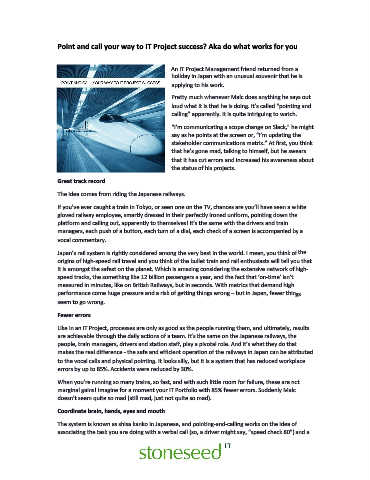
                    Japan’s rail system is rightly considered among the very best in the world. I mean, you think of the
                    origins of high-speed rail travel and you think of the bullet train and rail enthusiasts will tell you that
                    it is amongst the safest on the planet. Which is amazing considering the extensive network of high-
                    speed tracks, the something like 12 billion passengers a year, and the fact that ‘on-time’ isn’t
                    measured in minutes, like on British Railways, but in seconds. With metrics that demand high
                    performance come huge pressure and a risk of getting things wrong – but in Japan, fewer things
                    seem to go wrong.
                    Fewer errors

                    Like in an IT Project, processes are only as good as the people running them, and ultimately, results
                    are achievable through the daily actions of a team. It’s the same on the Japanese railways, the
                    people, train managers, drivers and station staff, play a pivotal role. And it’s what they do that
                    makes the real difference - the safe and efficient operation of the railways in Japan can be attributed
                    to the vocal calls and physical pointing. It looks silly, but it is a system that has reduced workplace
                    errors by up to 85%. Accidents were reduced by 30%.

                    When you’re running so many trains, so fast, and with such little room for failure, these are not
                    marginal gains! Imagine for a moment your IT Portfolio with 85% fewer errors. Suddenly Malc
                    doesn’t seem quite so mad (still mad, just not quite so mad).

                    Coordinate brain, hands, eyes and mouth

                    The system is known as shisa kanko in Japanese, and pointing-and-calling works on the idea of
                    associating the task you are doing with a verbal call (so, a driver might say, “speed check 80”) and a

