


Page 149 - Straight Talk On Project Management IV
P. 149
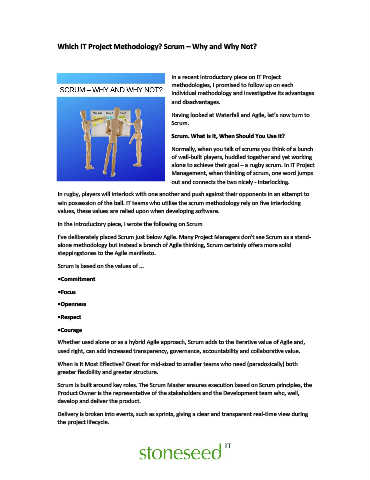
Which IT Project Methodology? Scrum – Why and Why Not?


                                                       In a recent introductory piece on IT Project
                                                       methodologies, I promised to follow up on each
                                                       individual methodology and investigative its advantages
                                                       and disadvantages.
                                                       Having looked at Waterfall and Agile, let’s now turn to
                                                       Scrum.

                                                       Scrum. What Is It, When Should You Use It?

                                                       Normally, when you talk of scrums you think of a bunch
                                                       of well-built players, huddled together and yet working
                                                       alone to achieve their goal – a rugby scrum. In IT Project
                                                       Management, when thinking of scrum, one word jumps
                                                       out and connects the two nicely - Interlocking.

               In rugby, players will interlock with one another and push against their opponents in an attempt to
               win possession of the ball. IT teams who utilise the scrum methodology rely on five interlocking
               values, these values are relied upon when developing software.
               In the introductory piece, I wrote the following on Scrum

               I've deliberately placed Scrum just below Agile. Many Project Managers don't see Scrum as a stand-
               alone methodology but instead a branch of Agile thinking, Scrum certainly offers more solid
               steppingstones to the Agile manifesto.

               Scrum is based on the values of ...
               •Commitment

               •Focus

               •Openness

               •Respect

               •Courage
               Whether used alone or as a hybrid Agile approach, Scrum adds to the iterative value of Agile and,
               used right, can add increased transparency, governance, accountability and collaborative value.

               When Is It Most Effective? Great for mid-sized to smaller teams who need (paradoxically) both
               greater flexibility and greater structure.

               Scrum is built around key roles. The Scrum Master ensures execution based on Scrum principles, the
               Product Owner is the representative of the stakeholders and the Development team who, well,
               develop and deliver the product.

               Delivery is broken into events, such as sprints, giving a clear and transparent real-time view during
               the project lifecycle.

