


Page 15 - Straight Talk On Project Management IV
P. 15
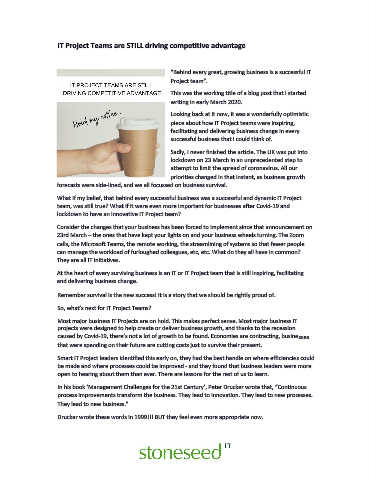
IT Project Teams are STILL driving competitive advantage


                                                         “Behind every great, growing business is a successful IT
                                                         Project team”.
                                                         This was the working title of a blog post that I started
                                                         writing in early March 2020.

                                                         Looking back at it now, it was a wonderfully optimistic
                                                         piece about how IT Project teams were inspiring,
                                                         facilitating and delivering business change in every
                                                         successful business that I could think of.

                                                         Sadly, I never finished the article. The UK was put into
                                                         lockdown on 23 March in an unprecedented step to
                                                         attempt to limit the spread of coronavirus. All our
                                                         priorities changed in that instant, as business growth
                    forecasts were side-lined, and we all focussed on business survival.
                    What if my belief, that behind every successful business was a successful and dynamic IT Project
                    team, was still true? What if it were even more important for businesses after Covid-19 and
                    lockdown to have an innovative IT Project team?
                    Consider the changes that your business has been forced to implement since that announcement on
                    23rd March – the ones that have kept your lights on and your business wheels turning. The Zoom
                    calls, the Microsoft Teams, the remote working, the streamlining of systems so that fewer people
                    can manage the workload of furloughed colleagues, etc, etc. What do they all have in common?
                    They are all IT initiatives.

                    At the heart of every surviving business is an IT or IT Project team that is still inspiring, facilitating
                    and delivering business change.

                    Remember survival is the new success! It is a story that we should be rightly proud of.

                    So, what’s next for IT Project Teams?
                    Most major business IT Projects are on hold. This makes perfect sense. Most major business IT
                    projects were designed to help create or deliver business growth, and thanks to the recession
                    caused by Covid-19, there’s not a lot of growth to be found. Economies are contracting, businesses
                    that were spending on their future are cutting costs just to survive their present.

                    Smart IT Project leaders identified this early on, they had the best handle on where efficiencies could
                    be made and where processes could be improved - and they found that business leaders were more
                    open to hearing about them than ever. There are lessons for the rest of us to learn.

                    In his book ‘Management Challenges for the 21st Century’, Peter Drucker wrote that, “Continuous
                    process improvements transform the business. They lead to innovation. They lead to new processes.
                    They lead to new business.”

                    Drucker wrote these words in 1999!!! BUT they feel even more appropriate now.

