


Page 42 - Straight Talk On Project Management IV
P. 42
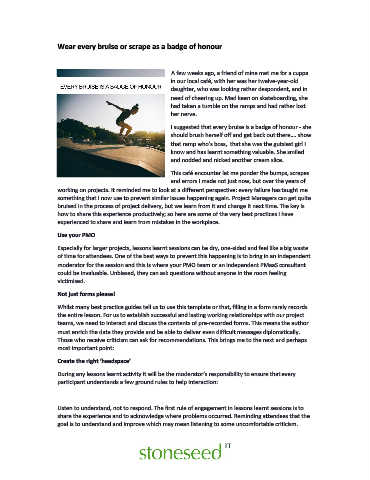
Wear every bruise or scrape as a badge of honour


                                                       A few weeks ago, a friend of mine met me for a cuppa
                                                       in our local café, with her was her twelve-year-old
                                                       daughter, who was looking rather despondent, and in
                                                       need of cheering up. Mad keen on skateboarding, she
                                                       had taken a tumble on the ramps and had rather lost
                                                       her nerve.

                                                       I suggested that every bruise is a badge of honour - she
                                                       should brush herself off and get back out there…. show
                                                       that ramp who’s boss,  that she was the gutsiest girl I
                                                       know and has learnt something valuable. She smiled
                                                       and nodded and nicked another cream slice.

                                                       This café encounter let me ponder the bumps, scrapes
                                                       and errors I made not just now, but over the years of
               working on projects. It reminded me to look at a different perspective: every failure has taught me
               something that I now use to prevent similar issues happening again. Project Managers can get quite
               bruised in the process of project delivery, but we learn from it and change it next time. The key is
               how to share this experience productively; so here are some of the very best practices I have
               experienced to share and learn from mistakes in the workplace.

               Use your PMO

               Especially for larger projects, lessons learnt sessions can be dry, one-sided and feel like a big waste
               of time for attendees. One of the best ways to prevent this happening is to bring in an independent
               moderator for the session and this is where your PMO team or an independent PMaaS consultant
               could be invaluable. Unbiased, they can ask questions without anyone in the room feeling
               victimised.

               Not just forms please!

               Whilst many best practice guides tell us to use this template or that, filling in a form rarely records
               the entire lesson. For us to establish successful and lasting working relationships with our project
               teams, we need to interact and discuss the contents of pre-recorded forms. This means the author
               must enrich the data they provide and be able to deliver even difficult messages diplomatically.
               Those who receive criticism can ask for recommendations. This brings me to the next and perhaps
               most important point:
               Create the right ‘headspace’

               During any lessons learnt activity it will be the moderator’s responsibility to ensure that every
               participant understands a few ground rules to help interaction:


               Listen to understand, not to respond. The first rule of engagement in lessons learnt sessions is to
               share the experience and to acknowledge where problems occurred. Reminding attendees that the
               goal is to understand and improve which may mean listening to some uncomfortable criticism.

