


Page 7 - Straight Talk On Project Management IV
P. 7
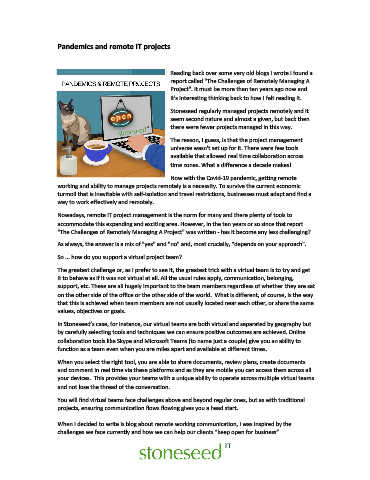
Pandemics and remote IT projects


                                                       Reading back over some very old blogs I wrote I found a
                                                       report called "The Challenges of Remotely Managing A
                                                       Project". It must be more than ten years ago now and
                                                       it's interesting thinking back to how I felt reading it.

                                                       Stoneseed regularly managed projects remotely and it
                                                       seem second nature and almost a given, but back then
                                                       there were fewer projects managed in this way.

                                                       The reason, I guess, is that the project management
                                                       universe wasn't set up for it. There were few tools
                                                       available that allowed real time collaboration across
                                                       time zones. What a difference a decade makes!
                                                       Now with the Covid-19 pandemic, getting remote
               working and ability to manage projects remotely is a necessity. To survive the current economic
               turmoil that is inevitable with self-isolation and travel restrictions, businesses must adapt and find a
               way to work effectively and remotely.

               Nowadays, remote IT project management is the norm for many and there plenty of tools to
               accommodate this expanding and exciting area. However, in the ten years or so since that report
               "The Challenges of Remotely Managing A Project" was written - has it become any less challenging?

               As always, the answer is a mix of "yes" and "no" and, most crucially, "depends on your approach".

               So ... how do you support a virtual project team?

               The greatest challenge or, as I prefer to see it, the greatest trick with a virtual team is to try and get
               it to behave as if it was not virtual at all. All the usual rules apply, communication, belonging,
               support, etc. These are all hugely important to the team members regardless of whether they are sat
               on the other side of the office or the other side of the world.  What is different, of course, is the way
               that this is achieved when team members are not usually located near each other, or share the same
               values, objectives or goals.
               In Stoneseed’s case, for instance, our virtual teams are both virtual and separated by geography but
               by carefully selecting tools and techniques we can ensure positive outcomes are achieved. Online
               collaboration tools like Skype and Microsoft Teams (to name just a couple) give you an ability to
               function as a team even when you are miles apart and available at different times.

               When you select the right tool, you are able to share documents, review plans, create documents
               and comment in real time via these platforms and as they are mobile you can access them across all
               your devices.  This provides your teams with a unique ability to operate across multiple virtual teams
               and not lose the thread of the conversation.

               You will find virtual teams face challenges above and beyond regular ones, but as with traditional
               projects, ensuring communication flows flowing gives you a head start.

               When I decided to write is blog about remote working communication, I was inspired by the
               challenges we face currently and how we can help our clients “keep open for business”

