


Page 83 - Straight Talk On Project Management IV
P. 83
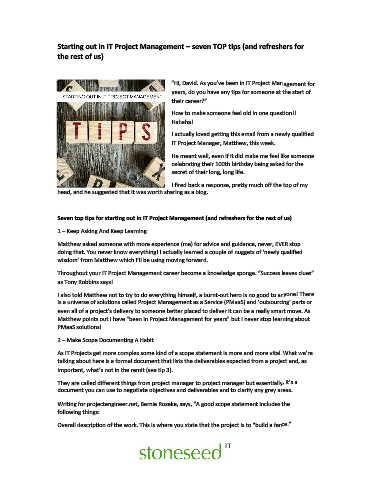
Starting out in IT Project Management – seven TOP tips (and refreshers for

               the rest of us)


                                                       “Hi, David. As you’ve been in IT Project Management for
                                                       years, do you have any tips for someone at the start of
                                                       their career?”

                                                       How to make someone feel old in one question!!
                                                       Hahaha!

                                                       I actually loved getting this email from a newly qualified
                                                       IT Project Manager, Matthew, this week.

                                                       He meant well, even if it did make me feel like someone
                                                       celebrating their 100th birthday being asked for the
                                                       secret of their long, long life.

                                                       I fired back a response, pretty much off the top of my
               head, and he suggested that it was worth sharing as a blog.


               Seven top tips for starting out in IT Project Management (and refreshers for the rest of us)

               1 – Keep Asking And Keep Learning

               Matthew asked someone with more experience (me) for advice and guidance, never, EVER stop
               doing that. You never know everything! I actually learned a couple of nuggets of ‘newly qualified
               wisdom’ from Matthew which I’ll be using moving forward.

               Throughout your IT Project Management career become a knowledge sponge. “Success leaves clues”
               as Tony Robbins says!

               I also told Matthew not to try to do everything himself, a burnt-out hero is no good to anyone! There
               is a universe of solutions called Project Management as a Service (PMaaS) and ‘outsourcing’ parts or
               even all of a project’s delivery to someone better placed to deliver it can be a really smart move. As
               Matthew points out I have “been in Project Management for years” but I never stop learning about
               PMaaS solutions!

               2 – Make Scope Documenting A Habit

               As IT Projects get more complex some kind of a scope statement is more and more vital. What we’re
               talking about here is a formal document that lists the deliverables expected from a project and, as
               important, what’s not in the remit (see tip 3).

               They are called different things from project manager to project manager but essentially, it’s a
               document you can use to negotiate objectives and deliverables and to clarify any grey areas.

               Writing for projectengineer.net, Bernie Roseke, says, “A good scope statement includes the
               following things:
               Overall description of the work. This is where you state that the project is to “build a fence.”

