


Page 371 - NEWGEN21-Proceedings-Full
P. 371
Koula                        Koula
      DEPOSIT GEOLOGY                                                                       SGDD072 – 9m @ 49.3 g/t           18.4 g/t Au

      Orebody Characteristics


      ▪   Veining and Mineralisation:                    Koula – SGRD1083 – 336 g/t Au
                                                                                                                     10.3 g/t
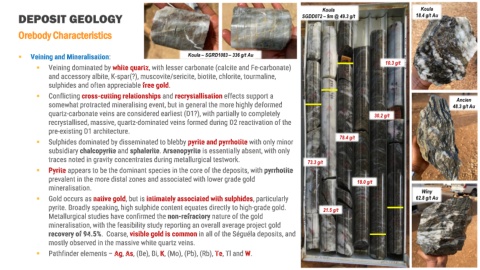
            ▪   Veining dominated by white quartz, with lesser carbonate (calcite and Fe-carbonate)
                and accessory albite, K-spar(?), muscovite/sericite, biotite, chlorite, tourmaline,
                sulphides and often appreciable free gold.
            ▪   Conflicting cross-cutting relationships and recrystallisation effects support a                                           Ancien
                somewhat protracted mineralising event, but in general the more highly deformed                                          48.3 g/t Au
                quartz-carbonate veins are considered earliest (D1?), with partially to completely               30.2 g/t
                recrystallised, massive, quartz-dominated veins formed during D2 reactivation of the
                pre-existing D1 architecture.
                                                                                                       78.4 g/t
            ▪   Sulphides dominated by disseminated to blebby pyrite and pyrrhotite with only minor
                subsidiary chalcopyrite and sphalerite. Arsenopyrite is essentially absent, with only
                traces noted in gravity concentrates during metallurgical testwork.          73.3 g/t
            ▪   Pyrite appears to be the dominant species in the core of the deposits, with pyrrhotite
                prevalent in the more distal zones and associated with lower grade gold                     18.0 g/t
                mineralisation.                                                                                                 Winy
            ▪   Gold occurs as native gold, but is intimately associated with sulphides, particularly                         62.8 g/t Au
                pyrite. Broadly speaking, high sulphide content equates directly to high-grade gold.   21.5 g/t
                Metallurgical studies have confirmed the non-refractory nature of the gold
                mineralisation, with the feasibility study reporting an overall average project gold
                recovery of 94.5%.  Coarse, visible gold is common in all of the Séguéla deposits, and
                mostly observed in the massive white quartz veins.
            ▪   Pathfinder elements – Ag, As, (Be), Bi, K, (Mo), (Pb), (Rb), Te, Tl and W.

