


Page 17 - gmj142-Jan-Mar2-mag-web
P. 17
Sideline investments at your peril


                                                   by Mark Andrews


              ith  COVID-19,  trade  relations                                    far the financial effects might be more
          Wand the rancorous US election                                          muted than 08/09,” he said.
          it  has  been  an  emotionally  draining                                “The flipside is that compared to the
          last nine months.                                                       GFC people have stress coming from
          Global stock markets felt the brunt of                                  multiple directions – financial stress to
          uncertainty  and  volatility  brought  on                               their portfolio, their future income and
          by the pandemic in March, but by and                                    the economy itself – as people have
          large rebounded strongly in the back                                    lost their jobs and opportunities, plus
          half of 2020.                                                           there is the health stresses, general
          However,  the  wellbeing  of  people                                    anxiety levels are higher than just the
          around  the  world  and  full  financial                                financial crisis.”
          fallout from the health crisis remains                                  An  indication  of  the  decisions
          immeasurable.                                                           investors  make  on  emotion  was
          Despite  the  unknowns,  behavioural                                    the tail-off of gold price and equities
          finance  experts  Oxford  Risk  have                                    towards the end of 2020, as progress
          warned retail investors of the perils of                                was made on COVID-19 vaccines.
          sidelining investments during a time of                                 Gold’s  status  as  a  safe  haven  for
          crisis.                                                                 investment  lost  a  little  sparkle,
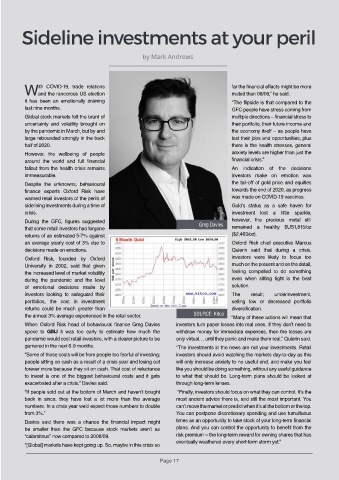
          During  the  GFC,  figures  suggested                                   however,  the  precious  metal  still
                                                                       Greg Davies
          that some retail investors had forgone                                  remained  a  healthy  $US1,815/oz
          returns of an estimated 5-7% against                                    ($2,463/oz).
          an average yearly cost of 3% due to                                     Oxford  Risk  chief  executive  Marcus
          decisions made on emotions.                                             Quierin  said  that  during  a  crisis,
          Oxford  Risk,  founded  by  Oxford                                      investors  were  likely  to  focus  too
          University  in  2002,  said  that  given                                much on the present and on the detail,
          the increased level of market volatility                                feeling  compelled  to  do  something
          during  the  pandemic  and  the  level                                  even  when  sitting  tight  is  the  best
          of  emotional  decisions  made  by                                      solution.
          investors  looking  to  safeguard  their                                The    result;   underinvestment,
          portfolios,  the  cost  in  investment                                  selling  low  or  decreased  portfolio
          returns  could  be  much  greater  than                                 diversification.
                                                                     SOURCE: Kitco
          the annual 3% average experienced in the retail sector.                 “Many of these actions will mean that
          When  Oxford  Risk  head  of  behavioural  finance  Greg  Davies   investors turn paper losses into real ones. If they don’t need to
          spoke  to  GMJ  it  was  too  early  to  estimate  how  much  the   withdraw money for immediate expenses, then the losses are
          pandemic would cost retail investors, with a clearer picture to be   only virtual… until they panic and make them real,” Quierin said.
          garnered in the next 6-9 months.                     “The investments in the news are not your investments. Retail
          “Some of those costs will be from people too fearful of investing;   investors should avoid watching the markets day-to-day as this
          people sitting on cash as a result of a crisis year and losing out   will only increase anxiety to no useful end, and make you feel
          forever more because they sit on cash. That cost of reluctance   like you should be doing something, without any useful guidance
          to  invest  is  one  of  the  biggest  behavioural  costs  and  it  gets   to what that should be. Long-term plans should be looked at
          exacerbated after a crisis,” Davies said.            through long-term lenses.
          “If people sold out at the bottom of March and haven’t bought    “Finally, investors should focus on what they can control. It’s the
          back  in  since,  they  have  lost  a  lot  more  than  the  average   most ancient advice there is, and still the most important. You
          numbers. In a crisis year we’d expect those numbers to double   can’t move the market or predict when it’s at the bottom or the top.
          from 3%.”                                            You can postpone discretionary spending and use tumultuous
          Davies  said  there  was  a  chance  the  financial  impact  might   times as an opportunity to take stock of your long-term financial
          be  smaller  than  the  GFC  because  stock  markets  aren’t  as   plans. And you can control the opportunity to benefit from the
          “calamitous” now compared to 2008/09.                risk premium – the long-term reward for owning shares that has
                                                               eventually weathered every short-term storm yet.”
          “[Global] markets have kept going up. So, maybe in this crisis so


                                                         Page 17

