


Page 45 - ATR 6 2018 web
P. 45
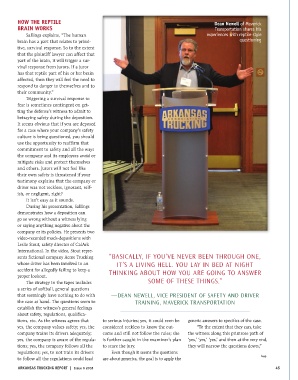
HOW THE REPTILE Dean Newell of Maverick
BRAIN WORKS Transportation shares his
Sallings explains, “The human experiences with reptile-style
brain has a part that relates to primi- questioning
tive, survival response. So to the extent
that the plaintiff lawyer can affect that
part of the brain, it will trigger a sur-
vival response from jurors. If a juror
has that reptile part of his or her brain
affected, then they will feel the need to
respond to danger to themselves and to
their community.”
Triggering a survival response to
fear is sometimes contingent on get-
ting the defense’s witness to admit to
betraying safety during the deposition.
It seems obvious that if you are deposed
for a case where your company’s safety
culture is being questioned, you should
use the opportunity to reaffirm that
commitment to safety and all the ways
the company and its employees avoid or
mitigate risks and protect themselves
and others. Jurors will not feel like
their own safety is threatened if your
testimony explains that the company or
driver was not reckless, ignorant, self-
ish, or negligent, right?
It isn’t easy as it sounds.
During his presentation, Sallings
demonstrates how a deposition can
go so wrong without a witness lying
or saying anything negative about the
company or its policies. He presents two
video-recorded mock-depositions with
Leslie Stout, safety director of CalArk
International. In the video, Stout repre-
sents fictional company Acme Trucking “BASICALLY, IF YOU’VE NEVER BEEN THROUGH ONE,
whose driver has been involved in an IT’S A LIVING HELL. YOU LAY IN BED AT NIGHT
accident for allegedly failing to keep a THINKING ABOUT HOW YOU ARE GOING TO ANSWER
proper lookout.
The strategy in the tapes includes SOME OF THESE THINGS.”
a series of softball, general questions
that seemingly have nothing to do with —DEAN NEWELL, VICE PRESIDENT OF SAFETY AND DRIVER
the case at hand. The questions seem to TRAINING, MAVERICK TRANSPORTATION
establish the witness’s general feelings
about safety, regulations, qualifica-
tions, etc. As the witness agrees that to serious injuries; yes, it could even be generic answers to specifics of the case.
yes, the company values safety; yes, the considered reckless to know the out- “To the extent that they can, take
company trains its drivers adequately; come and still not follow the rules; she the witness along this primrose path of
yes, the company is aware of the regula- is further caught in the examiner’s plan ‘yes,’ ‘yes,’ ‘yes,’ and then at the very end,
tions; yes, the company follows all the to scare the jury. they will narrow the questions down,”
regulations; yes, to not train its drivers Even though it seems the questions
to follow all the regulations could lead are about generics, the goal is to apply the
ARKANSAS TRUCKING REPORT | Issue 6 2018 45

