


Page 35 - ATR 4 2013
P. 35
included in FMCSA’s analysis, par-
                                                                              ticularly those related to the expected
                                                                              shift of some nighttime drivers to
                                                                              daytime operations. By limiting its
                                                                              productivity calculations to lost work
                                                                              hours for drivers in its extreme driving
                                                                              groups, FMCSA ignores costs related
                                                                              to increased congestion exposure and
                                                                              increased restart times which will
                                                                              be experienced across a much larger
                                                                              percentage of the driving population.
                                                                              Components of the restart provisions
                                                                              may also result in shipper costs, sched-
                                                                              uling issues and could exacerbate the
                                                                              ongoing driver shortage.
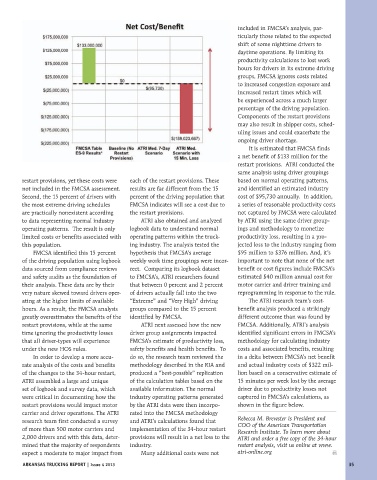
                                                                                  It is estimated that FMCSA finds
                                                                              a net benefit of $133 million for the
                                                                              restart provisions.  ATRI conducted the
                                                                              same analysis using driver groupings
        restart provisions, yet these costs were   each of the restart provisions. These   based on normal operating patterns,
        not included in the FMCSA assessment.   results are far different from the 15   and identified an estimated industry
        Second, the 15 percent of drivers with   percent of the driving population that   cost of $95,730 annually.  In addition,
        the most extreme driving schedules   FMCSA indicates will see a cost due to   a series of reasonable productivity costs
        are practically nonexistent according   the restart provisions.       not captured by FMCSA were calculated
        to data representing normal industry   ATRI also obtained and analyzed   by ATRI using the same driver group-
        operating patterns.  The result is only   logbook data to understand normal   ings and methodology to monetize
        limited costs or benefits associated with   operating patterns within the truck-  productivity loss, resulting in a pro-
        this population.                   ing industry. The analysis tested the   jected loss to the industry ranging from
            FMCSA identified this 15 percent   hypothesis that FMCSA’s average   $95 million to $376 million. And, it’s
        of the driving population using logbook   weekly work time groupings were incor-  important to note that none of the net
        data sourced from compliance reviews   rect.  Comparing its logbook dataset   benefit or cost figures include FMCSA’s
        and safety audits as the foundation of   to FMCSA’s, ATRI researchers found   estimated $40 million annual cost for
        their analysis. These data are by their   that between 0 percent and 2 percent   motor carrier and driver training and
        very nature skewed toward drivers oper-  of drivers actually fall into the two   reprogramming in response to the rule.
        ating at the higher limits of available   “Extreme” and “Very High” driving   The ATRI research team’s cost-
        hours. As a result, the FMCSA analysis   groups compared to the 15 percent   benefit analysis produced a strikingly
        greatly overestimates the benefits of the   identified by FMCSA.      different outcome than was found by
        restart provisions, while at the same   ATRI next assessed how the new   FMCSA. Additionally, ATRI’s analysis
        time ignoring the productivity losses   driver group assignments impacted   identified significant errors in FMCSA’s
        that all driver-types will experience   FMCSA’s estimate of productivity loss,   methodology for calculating industry
        under the new HOS rules.           safety benefits and health benefits.  To   costs and associated benefits, resulting
            In order to develop a more accu-  do so, the research team reviewed the   in a delta between FMCSA’s net benefit
        rate analysis of the costs and benefits   methodology described in the RIA and   and actual industry costs of $322 mil-
        of the changes to the 34-hour restart,   produced a “best-possible” replication   lion based on a conservative estimate of
        ATRI assembled a large and unique   of the calculation tables based on the   15 minutes per week lost by the average
        set of logbook and survey data, which   available information. The normal   driver due to productivity losses not
        were critical in documenting how the   industry operating patterns generated   captured in FMCSA’s calculations, as
        restart provisions would impact motor   by the ATRI data were then incorpo-  shown in the figure below.
        carrier and driver operations. The ATRI   rated into the FMCSA methodology
        research team first conducted a survey   and ATRI’s calculations found that   Rebecca M. Brewster is President and
        of more than 500 motor carriers and   implementation of the 34-hour restart   COO of the American Transportation
                                                                              Research Institute. To learn more about
        2,000 drivers and with this data, deter-  provisions will result in a net loss to the   ATRI and order a free copy of the 34-hour
        mined that the majority of respondents   industry.                    restart analysis, visit us online at www.
        expect a moderate to major impact from   Many additional costs were not   atri-online.org

        arkansas Trucking reporT | issue 4 2013                                                                   35

