


Page 11 - CEFR Infographics by RTNLC Miscellaneous
P. 11
5


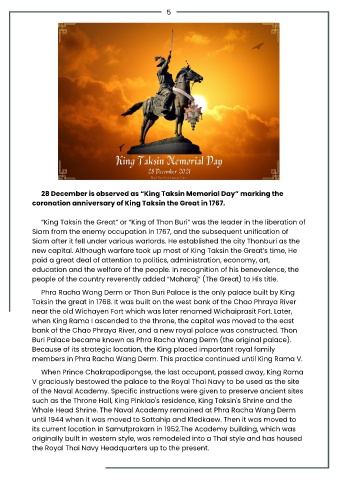
                 28 December is observed as “King Taksin Memorial Day” marking the
            coronation anniversary of King Taksin the Great in 1767.


                 “King Taksin the Great” or “King of Thon Buri” was the leader in the liberation of
            Siam from the enemy occupation in 1767, and the subsequent unification of
            Siam after it fell under various warlords. He established the city Thonburi as the
            new capital. Although warfare took up most of King Taksin the Great’s time, He
            paid a great deal of attention to politics, administration, economy, art,
            education and the welfare of the people. In recognition of his benevolence, the
            people of the country reverently added “Maharaj” (The Great) to His title.

                 Phra Racha Wang Derm or Thon Buri Palace is the only palace built by King
            Taksin the great in 1768. It was built on the west bank of the Chao Phraya River
            near the old Wichayen Fort which was later renamed Wichaiprasit Fort. Later,
            when King Rama I ascended to the throne, the capital was moved to the east
            bank of the Chao Phraya River, and a new royal palace was constructed. Thon

            Buri Palace became known as Phra Racha Wang Derm (the original palace).
            Because of its strategic location, the King placed important royal family
            members in Phra Racha Wang Derm. This practice continued until King Rama V.

                 When Prince Chakrapadipongse, the last occupant, passed away, King Rama
            V graciously bestowed the palace to the Royal Thai Navy to be used as the site
            of the Naval Academy. Specific instructions were given to preserve ancient sites
            such as the Throne Hall, King Pinklao's residence, King Taksin's Shrine and the
            Whale Head Shrine. The Naval Academy remained at Phra Racha Wang Derm
            until 1944 when it was moved to Sattahip and Kledkaew. Then it was moved to
            its current location in Samutprakarn in 1952.The Academy building, which was
            originally built in western style, was remodeled into a Thai style and has housed
            the Royal Thai Navy Headquarters up to the present.

