


Page 224 - The City and Guilds Textbook: Plumbing Book 1 for the Level 3 Apprenticeship (9189), Level 2 Technical Certificate (8202) and Level 2 Diploma (6035)
P. 224
The City & Guilds Textbook: Plumbing Book 1

                                            language what we must do for correct and safe operation of their equipment.
                                            This guidance must be followed, otherwise:

                                            l  the terms of the warranty will be void
                                            l  the installation may be dangerous
                                            l  we may inadvertently be breaking the regulations.

                                            In some instances, it may seem that the instructions contradict the regulations or
                                            the British Standards. This is because regulations are reviewed only periodically,
                                            whereas manufacturers are moving forward all the time with new, more efficient
                                            products, so their information may be more up to date. In these cases, follow a
                                            simple but effective rule: the manufacturers’ guidance must be followed at all times.

                                            3 COMMUNICATING WITH OTHERS

                                            A company cannot function properly without proper methods of communication,
                                            whether a formal letter, an email, memo, fax or verbal instructions. Formal and
                                            informal communications take place in the workplace every day. Most people
                                            believe that formal communication is written communication but this is not the
                                            case. In a work context, communication in any form that is about your job should
                                            always be regarded as formal communication.

                                            Methods of communication at work

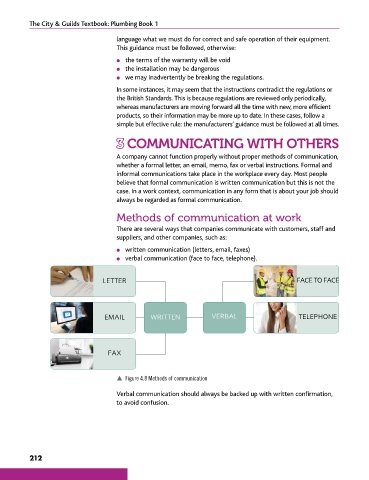
                                            There are several ways that companies communicate with customers, staff and
                                            suppliers, and other companies, such as:
                                            l  written communication (letters, email, faxes)
                                            l  verbal communication (face to face, telephone).


                                        LETTER                                                        FACE TO FACE


                                                                                                          EMAIL

                                        EMAIL          WRITTEN             VERBAL                      TELEPHONE


                                         FAX


                                            p  Figure 4.8 Methods of communication

                                            Verbal communication should always be backed up with written confirmation,
                                            to avoid confusion.


                212


        9781510416482.indb   212                                                                                    29/03/19   8:56 PM

