


Page 526 - The City and Guilds Textbook: Plumbing Book 1 for the Level 3 Apprenticeship (9189), Level 2 Technical Certificate (8202) and Level 2 Diploma (6035)
P. 526
The City & Guilds Textbook: Plumbing Book 1
system was installed; others take rather more investigative work. Sometimes
the system itself will be leading you to the problem by the way it is behaving or
the noises it makes, and so diagnosis becomes an easy task.
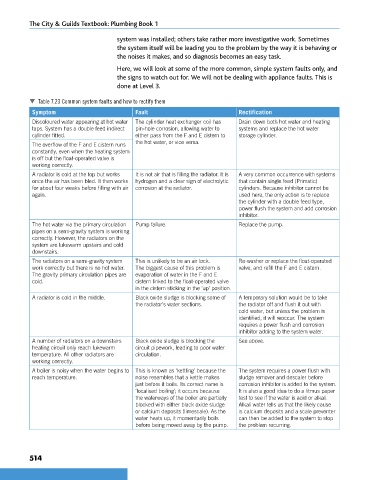
Here, we will look at some of the more common, simple system faults only, and
the signs to watch out for. We will not be dealing with appliance faults. This is
done at Level 3.
Table 7.23 Common system faults and how to rectify them
Symptom Fault Rectification
Discoloured water appearing at hot water The cylinder heat exchanger coil has Drain down both hot water and heating
taps. System has a double feed indirect pin-hole corrosion, allowing water to systems and replace the hot water
cylinder fitted. either pass from the F and E cistern to storage cylinder.
The overflow of the F and E cistern runs the hot water, or vice versa.
constantly, even when the heating system
is off but the float-operated valve is
working correctly.
A radiator is cold at the top but works It is not air that is filling the radiator. It is A very common occurrence with systems
once the air has been bled. It then works hydrogen and a clear sign of electrolytic that contain single feed (Primatic)
for about four weeks before filling with air corrosion at the radiator. cylinders. Because inhibitor cannot be
again. used here, the only action is to replace
the cylinder with a double feed type,
power flush the system and add corrosion
inhibitor.
The hot water via the primary circulation Pump failure. Replace the pump.
pipes on a semi-gravity system is working
correctly. However, the radiators on the
system are lukewarm upstairs and cold
downstairs.
The radiators on a semi-gravity system This is unlikely to be an air lock. Re-washer or replace the float-operated
work correctly but there is no hot water. The biggest cause of this problem is valve, and refill the F and E cistern.
The gravity primary circulation pipes are evaporation of water in the F and E
cold. cistern linked to the float-operated valve
in the cistern sticking in the ‘up’ position.
A radiator is cold in the middle. Black oxide sludge is blocking some of A temporary solution would be to take
the radiator’s water sections. the radiator off and flush it out with
cold water, but unless the problem is
identified, it will reoccur. The system
requires a power flush and corrosion
inhibitor adding to the system water.
A number of radiators on a downstairs Black oxide sludge is blocking the See above.
heating circuit only reach lukewarm circuit pipework, leading to poor water
temperature. All other radiators are circulation.
working correctly.
A boiler is noisy when the water begins to This is known as ‘kettling’ because the The system requires a power flush with
reach temperature. noise resembles that a kettle makes sludge remover and descaler before
just before it boils. Its correct name is corrosion inhibitor is added to the system.
‘localised boiling’; it occurs because It is also a good idea to do a litmus paper
the waterways of the boiler are partially test to see if the water is acid or alkali.
blocked with either black oxide sludge Alkali water tells us that the likely cause
or calcium deposits (limescale). As the is calcium deposits and a scale preventer
water heats up, it momentarily boils can then be added to the system to stop
before being moved away by the pump. the problem recurring.
514
9781510416482.indb 514 29/03/19 9:04 PM

