


Page 628 - The City and Guilds Textbook: Plumbing Book 1 for the Level 3 Apprenticeship (9189), Level 2 Technical Certificate (8202) and Level 2 Diploma (6035)
P. 628
The City & Guilds Textbook: Plumbing Book 1


                 KEY POINT                  Cleaning out the overflows of the appliances
                 Make a note of all         Belfast sink overflow are notorious for blocking. These can be cleaned with stiff
                                            wire and then thoroughly flushed out.
                 actions taken on the
                 maintenance report.
                                            Checking access covers
                                            These should be checked for leakage and tested to ensure that the bolts on the
                                            access door are free moving. A little silicone grease will prevent the bolts from
                 HEALTH AND SAFETY          rusting. Also, check the rubber seals to make sure that they are not showing

                 When dealing with          signs of perishing.
                 blockages, always wear
                 the correct PPE, including   Checking the pipework
                 rubber gauntlets, eye      Pipework is often neglected during periodic maintenance. Always check for signs
                 protection, a face mask,   of leakage and that the clips are in good order, especially if the soil and waste
                 full boiler suit and       pipes are external as they can be affected by the weather. Direct sunlight is
                 wellington boots.
                                            especially damaging to pipework and clips. Damaged or broken clips should be
                                            replaced. Also, check the cage on the top of the stack as these often blow off in
                                            high winds. These should be replaced as necessary.

                                            Check for signs of overflowing WC cisterns
                                            Adjust the water levels and check their correct operation.

                                            Dealing with blockages

                                            Unblocking drains and soil stack pipework is probably the most unpleasant of all
                                            the jobs a plumber undertakes, and can pose a real health risk.


                                            Blocked soil pipes
                                            There are a number of reasons why soil pipes and drains block. Often, it can be
                                            attributed to three possible causes:

                                            1  A broken drain: if this is suspected, there is very little we, as plumbers, can
                                               do. The drain will probably need a camera inspection to accurately pinpoint
                                               the problem. Broken drains often occur because of ground compression or
                                               movement.
                                            2  A tree root growing through the drain: again, if this is suspected, a camera
                                               inspection will be necessary.
                                            3  A physical blockage: these are usually caused by something being flushed
                                               down the toilet and eventually becoming wedged in the drain. These can
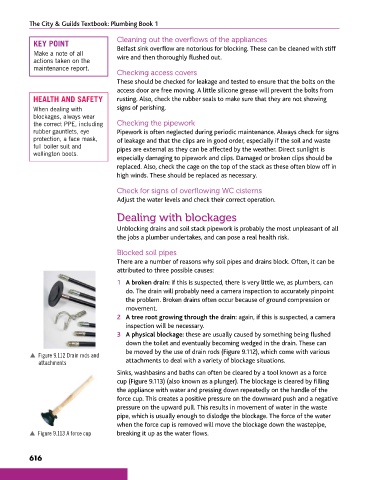
                                               be moved by the use of drain rods (Figure 9.112), which come with various
                p  Figure 9.112 Drain rods and
                   attachments                 attachments to deal with a variety of blockage situations.
                                            Sinks, washbasins and baths can often be cleared by a tool known as a force
                                            cup (Figure 9.113) (also known as a plunger). The blockage is cleared by filling
                                            the appliance with water and pressing down repeatedly on the handle of the
                                            force cup. This creates a positive pressure on the downward push and a negative
                                            pressure on the upward pull. This results in movement of water in the waste
                                            pipe, which is usually enough to dislodge the blockage. The force of the water
                                            when the force cup is removed will move the blockage down the wastepipe,
                p  Figure 9.113 A force cup  breaking it up as the water flows.


                616


        9781510416482.indb   616                                                                                    29/03/19   9:08 PM

