


Page 233 - English for Writing Research Papers
P. 233
218

            13.1                     What's the buzz?


                 1)     Below  is  a  structured  abstract  ( 13.10 ) entitled  Language and publication in
              Cardiovascular Research articles  and was published in the international journal
                Cardiovascular Research . The author, Robert Coates, talks about the reasons
              why papers are and are not accepted for publication.

              Read the abstract and think about:


              •   how it is structured and what information is contained in each of the four parts
              •   how relevant Dr Coates’ research is in terms of you writing a manuscript for

                 publication in an international journal

              •    what kinds of English language errors you tend to make when writing papers
                 and how you could avoid them

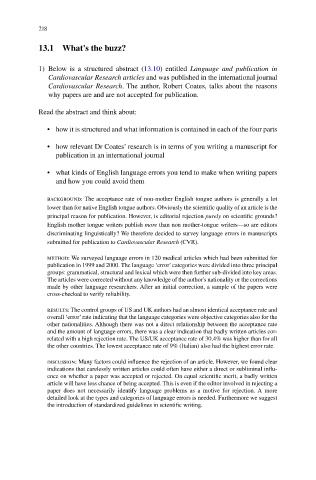
                 background : The acceptance rate of non-mother English tongue authors is generally a lot
              lower than for native English tongue authors. Obviously the scientific quality of an article is the

              principal reason for publication. However, is editorial rejection  purely  on scientifi c grounds?
              English mother tongue writers publish  more  than non mother-tongue writers—so are editors
              discriminating linguistically? We therefore decided to survey language errors in manuscripts
              submitted for publication to  Cardiovascular Research  (CVR).
                 method : We surveyed language errors in 120 medical articles which had been submitted for
              publication in 1999 and 2000. The language ‘error’ categories were divided into three principal
              groups: grammatical, structural and lexical which were then further sub-divided into key areas.
              The articles were corrected without any knowledge of the author's nationality or the corrections
              made by other language researchers. After an initial correction, a sample of the papers were
              cross-checked to verify reliability.
                 results : The control groups of US and UK authors had an almost identical acceptance rate and
              overall ‘error’ rate indicating that the language categories were objective categories also for the
              other nationalities. Although there was not a direct relationship between the acceptance rate
              and the amount of language errors, there was a clear indication that badly written articles cor-
              related with a high rejection rate. The US/UK acceptance rate of 30.4% was higher than for all
              the other countries. The lowest acceptance rate of 9% (Italian) also had the highest error rate.
                 discussion : Many factors could influence the rejection of an article. However, we found clear

              indications that carelessly written articles could often have either a direct or subliminal infl u-

              ence on whether a paper was accepted or rejected. On equal scientific merit, a badly written
              article will have less chance of being accepted. This is even if the editor involved in rejecting a
              paper does not necessarily identify language problems as a motive for rejection. A more
              detailed look at the types and categories of language errors is needed. Furthermore we suggest
              the introduction of standardized guidelines in scientific writing.

