


Page 117 - Xanathar's Guide To Everything
P. 117
LEVEL AND LETHALITY
                                                                     Before creating a trap’s effects, think about its level and
                                                                     its lethality.
                                                                      Traps are divided into four level ranges: 1—4, 5—10,
                                                                     11—16, and 17—20. The level you choose for a trap gives
                                                                     you a starting point for determining its potency.
                                                                      To further delineate the trap's strength, decide
                                                                     whether it is a moderate, dangerous, or deadly threat to
                                                                     characters in its level range. A moderate trap is unlikely
                                                                     to kill a character. A dangerous trap typically deals
                                                                     enough damage that a character hit by one is eager for
                                                                     healing. A deadly trap might reduce a creature to 0 hit
                                                                     points in one shot, and leaves most creatures hit by it in
                                                                     need of a short or long rest.
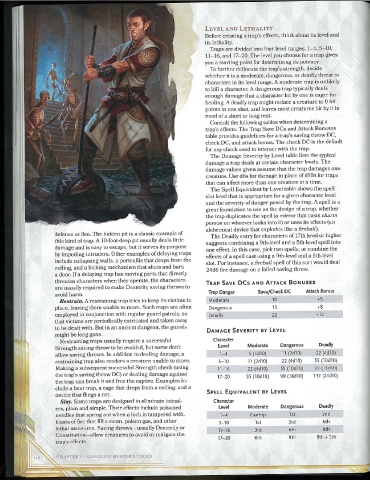
                                                                       Consult the following tables when determining a
                                                                     trap’s effects. The Trap Save DCs and Attack Bonuses
                                                                     table provides guidelines for a trap’s saving throw DC,
                                                                     check DC, and attack bonus. The check DC is the default
                                                                     for any check used to interact with the trap.
                                                                       The Damage Severity by Level table lists the typical
                                                                     damage a trap deals at certain character levels. The
                                                                     damage values given assume that the trap damages one
                                                                     creature. Use d6s for damage in place of dIOS for traps
                                                                     that can affect more than one creature at a time.
                                                                       The Spell Equivalent by Level table shows the spell
                                                                     slot level that is appropriate for a given character level
                                                                     and the severity of danger posed by the trap. A spell is a
                                                                     great foundation to use as the design of a trap, whether
                                                                     the trap duplicates the spell (a mirror that casts charm
                                                                     person on whoever looks into it) or uses its effects (an
                                                                     alchemical device that explodes like a fireball).
                   defense or flee. The hidden pit is a classic example of  The Deadly entry for characters of 17th level or higher
                   this kind of trap. A lO-foot—deep pit usually deals little  suggests combining a 9th—level and a 5th-level spell into
                   damage and is easy to escape, but it serves its purpose  one effect. In this case, pick two spells, or combine the
                   by impeding intruders. Other examples of delaying traps  effects of a spell cast using a 9th-level and a 5th—level
                   include collapsing walls, a portcullis that drops from the  slot. For instance, a fireball spell of this sort would deal
                   ceiling, and a locking mechanism that shuts and bars  24d6 fire damage on a failed saving throw.
                   a door. If a delaying trap has moving parts that directly
                   threaten characters when they operate, the characters  TRAP SAVE DCs AND ATTACK BONUSES
                   are usually required to make Dexterity saving throws to                            Attack Bonus
                   avoid harm.                                        Trap Danger     Save/Check DC
                     Restrain. A restraining trap tries to keep its victims in  Moderate   10             +5
                   place, leaving them unable to move. Such traps are often  Dangerous     15             +8
                   employed in conjunction with regular guard patrols, so  Deadly          20             +12
                   that victims are periodically extricated and taken away
                   to be dealt with. But in an ancient dungeon, the guards  DAMAGE SEVERITY BY LEVEL
                   might be long gone.
                     Restraining traps usually require a successful    Character                          Deadly
                   Strength saving throw to be avoided, but some don’t   Level     Moderate   Dangerous
                   allow saving throws. In addition to dealing damage, a  1—4      5 (ll)     ll (2l)    22 (4l)
                   restraining trap also renders a creature unable to move.  5—10  11 (Zl)    22 (4dl0)  55 (lDl)
                   Making a subsequent successful Strength check (using  11—16     22 (4l)    55 (lOl)   99 {13d10)
                   the trap’s saving throw DC) or dealing damage against  17—20    55 (lOl)   99 (lSl)   132 (24l)
                   the trap can break it and free the captive. Examples in-
                   clude a bear trap, a cage that drops from a ceiling, and a
                   device that flings a net.                          SPELL EQUIVALENT BY LEVEL
                     Slay. Some traps are designed to eliminate intrud—  Character
                   ers, plain and simple. Their effects include poisoned  Level    Moderate   Dangerous    Deadly
                   needles that spring out when a lock is tampered with,  1—4       Cantrip      lst        2nd
                   blasts of fire that fill a room, poison gas, and other  5—10        lst         3rd        6th
                   lethal measures. Saving throws—usually Dexterity or   11—16       3rd         6th        9th
                   Constitution-wallow creatures to avoid or mitigate the  17—20     6th         9th      9th + 5th
                   traps effects.


                    i". ii -‘\. Ell [5 33 L‘ i  l.) L] hi i I- ll.) 55 El AFTE l-l'.‘ .5 'l'i..l'tf31i‘i

