


Page 111 - Module DMV20173
P. 111
6.0    POLYMER PROCESSING

                                 CHAPTER 6: POLYMER PROCESSING


                  6.0   INTRODUCTION


                  Plastics  are  made  from  fossil  fuels-petroleum,  natural  gas,  coal,  wood  and  some  plant
                  materials,  air,  water  and  sometimes  other  common  materials.  They  are  designed  in  many
                  different formulas for different purposes. Today plastics are taken for granted. They form part of
                  our everyday life to such an extent that it would be impossible to imagine being without them.

                  This situation has come about in the last 60 years or so. Products are now designed and made
                  form  plastic  materials  because  they  offer  property  combinations  not  available  with  other
                  materials,  such  as  lightness,  resistance  to  corrosion  colour,  transparency  and  ease  of
                  processing. In spite  of their limitations  their  exploration is  generally limited by the designer’s

                  inequity. “Well its made of plastic” it is statement that is often heard. The common high tonnage
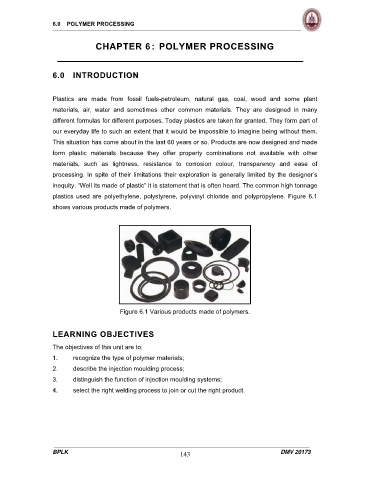
                  plastics  used  are  polyethylene,  polystyrene,  polyvinyl  chloride  and  polypropylene.  Figure  6.1
                  shows various products made of polymers.


                                         Figure 6.1 Various products made of polymers.

                  LEARNING OBJECTIVES

                  The objectives of this unit are to:
                  1.     recognize the type of polymer materials;
                  2.     describe the injection moulding process;

                  3.     distinguish the function of injection moulding systems;
                  4.     select the right welding process to join or cut the right product.


                  BPLK                                       143                                  DMV 20173

