


Page 11 - 21 Fall Newsletter
P. 11
The Do’s and Don’ts of Prescribing
Controlled Substances
Tanner Trantham, PharmD, FACVP the quantity is within the scope of practice. However, some
Staff Pharmacist, Realo Veterinary Pharmacy state laws do require a limit (e.g., some limit to only a 30‐
One of the most important responsibilities of a pharmacist day supply – North Carolina does not). These prescriptions
is to make sure a prescription is legitimate and that all legal are also not permitted to have any additional refills.
requirements are met throughout the dispensing process. Schedule III‐IV
This is especially true regarding controlled substance A prescription for a schedule III or IV medication may be
prescriptions. Though they are not as prevalent as in written, electronic, faxed, or called‐in to the dispensing
human medicine, certain controlled substances are still the pharmacy. These prescriptions may not have more than 5
mainstay of treatment for several conditions in veterinary refills authorized or be filled more than 6 months after the
medicine. However, much confusion remains around the original written date.
particular requirements related to prescriptions for
Schedule V
controlled substances.
These medications are rarely prescribed in veterinary
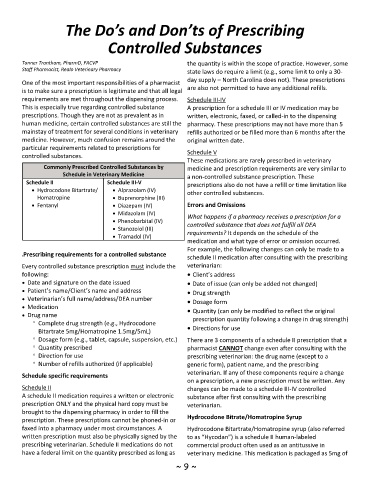
Commonly Prescribed Controlled Substances by medicine and prescription requirements are very similar to
Schedule in Veterinary Medicine a non‐controlled substance prescription. These
Schedule II Schedule III‐V prescriptions also do not have a refill or time limitation like
Hydrocodone Bitartrate/ Alprazolam (IV) other controlled substances.
Homatropine Buprenorphine (III)
Fentanyl Diazepam (IV) Errors and Omissions
Midazolam (IV) What happens if a pharmacy receives a prescription for a
Phenobarbital (IV) controlled substance that does not fulfill all DEA
Stanozolol (III)
Tramadol (IV) requirements? It depends on the schedule of the
medication and what type of error or omission occurred.
For example, the following changes can only be made to a
cPrescribing requirements for a controlled substance schedule II medication after consulting with the prescribing
Every controlled substance prescription must include the veterinarian:
following: Client’s address
Date and signature on the date issued Date of issue (can only be added not changed)
Patient’s name/Client’s name and address Drug strength
Veterinarian’s full name/address/DEA number
Dosage form
Medication Quantity (can only be modified to reflect the original
Drug name
Complete drug strength (e.g., Hydrocodone prescription quantity following a change in drug strength)
Bitartrate 5mg/Homatropine 1.5mg/5mL) Directions for use
Dosage form (e.g., tablet, capsule, suspension, etc.) There are 3 components of a schedule II prescription that a
Quantity prescribed pharmacist CANNOT change even after consulting with the
Direction for use prescribing veterinarian: the drug name (except to a
Number of refills authorized (if applicable) generic form), patient name, and the prescribing
veterinarian. If any of these components require a change
Schedule specific requirements
on a prescription, a new prescription must be written. Any
Schedule II changes can be made to a schedule III‐IV controlled
A schedule II medication requires a written or electronic substance after first consulting with the prescribing
prescription ONLY and the physical hard copy must be veterinarian.
brought to the dispensing pharmacy in order to fill the
prescription. These prescriptions cannot be phoned‐in or Hydrocodone Bitrate/Homatropine Syrup
faxed into a pharmacy under most circumstances. A Hydrocodone Bitartrate/Homatropine syrup (also referred
written prescription must also be physically signed by the to as “Hycodan”) is a schedule II human‐labeled
prescribing veterinarian. Schedule II medications do not commercial product often used as an antitussive in
have a federal limit on the quantity prescribed as long as veterinary medicine. This medication is packaged as 5mg of
~ 9 ~

