


Page 76 - Template Tesis UTM v2.0
P. 76
Israr et al. [91] investigated the damage behaviours of the pure bamboo under

                   quasi static indentation test with the aid of Linear Variable Differential Transformer
                   (LVDT) apparatus to monitor the accuracy of specimen’s displacement. In this study,

                   two similar specimens of the pure bamboo were tested, marked as B1 and B2. Both
                   specimens  were  indented  up  to  maximum  of  8.0  mm  and  the  load  was  unloaded

                   automatically after reaching this point. From load-deflection curves, it was observed
                   that the load sustained by the specimen seemed to increase gradually with the increase

                   in displacement. For further investigation, both specimens were retested at the same

                   spot and it was observed that sample B1 recorded the decreasing peak load from 950
                   to 900 N while B2 shows a small increment. Based on SEM images, there was no

                   significant  difference  for  the  damage  from  first  and  second  impact  of  B2  on  the
                   permanent indentation. However, sample B1 was broken into two pieces in the second

                   re-indentation after the displacement reached 7.8 mm. It might be due to the drastic
                   propagation of the intra-laminar damage in the fibre direction and the presence of

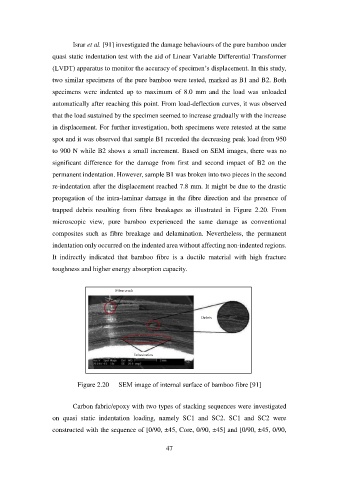
                   trapped  debris  resulting  from  fibre  breakages  as  illustrated  in  Figure  2.20.  From

                   microscopic  view,  pure  bamboo  experienced  the  same  damage  as  conventional
                   composites  such  as  fibre  breakage  and  delamination.  Nevertheless,  the  permanent

                   indentation only occurred on the indented area without affecting non-indented regions.

                   It  indirectly  indicated  that  bamboo  fibre  is  a  ductile  material  with  high  fracture
                   toughness and higher energy absorption capacity.


                                          Fibre crack


                                                                        Debris


                                                Delamination


                            Figure 2.20    SEM image of internal surface of bamboo fibre [91]


                           Carbon fabric/epoxy with two types of stacking sequences were investigated

                   on  quasi  static  indentation  loading,  namely  SC1  and  SC2.  SC1  and  SC2  were
                   constructed with the sequence of [0/90, ±45, Core, 0/90, ±45] and [0/90, ±45, 0/90,


                                                           47

