


Page 20 - 1202 Question Bank Additional Mathematics Form 5
P. 20
125
75
2 4
= —– + 75 – —–– – 0 (b) f : (x, y) → (x – y, x + 2y) (α + 1)(β + 1) = –1
3 2
αβ + (α + β) + 1 = –1
f : (2, 3) → (–1, 8)
1
= 50 m f : (–1, 8) → (–9, 15) αβ = –1 – 1 – —
∴ B(–1, 8), C(–9, 15) 2
5
25. (a) v = 2t(10 – 3t) (c) f (x) = 3 – 4x = – —
v = 20t – 6t 2 Let y = 3 – 4x = –3 1 1 2
dv
a = —– 6 = 4x If — and — are roots,
α
β
dt
3
1
1
α + β
a = 20 – 12t x = — — + — = ——––
2
For maximum velocity, 3 α β αβ
1
–1
a = 0 ∴ f (–3) = — —
2
2
20 – 12t = 0 = ——
5
12t = 20 2. (a) y = f (x) + 1 – —
2
–2 < y < 3
©PAN ASIA PUBLICATIONS
5
t = — –2 < f (x) + 1 < 3 = – —
1
3
5
5
–3 < f (x) < 2
When t = —, (b) f (x) = x + 2 —– = ——– = – —
1
2
1
3
5
5
5
3 22
3 2
2
v = 2 — 10 – 3 — gf (x) = x + 4x + 2 αβ – — 5
2
50
v = —– gf (x) = g(x + 2) Therefore, the equation is
Let
y = x + 2
3 1 2
2
Therefore, the maximum velocity of x = y – 2 2 x + —x – — = 0
5
5
50
2
the particle is —– m s . g(y) = (y – 2) + 4(y – 2) + 2 5x + x – 2 = 0
–1
2
3 = y – 4y + 4 + 4y – 8 + 2
∫
2
(b) s = v dt (i) = y – 2 2 5. (a) Midpoint AC = (3, 1)
g(x) = x – 2
y
∫
s = (20t – 6t ) dt g(2) = 2 – 2 = 2
2
2
s = 10t – 2t + c (ii) 2 fg(x) = 9 A(1, 4)
2
3
When t = 0, s = 0 f (x – 2) = 9 D(h, k)
2
10(0) – 2(0) + c = 0 x – 2 + 2 = 9
2
3
2
c = 0 x = 9 B(–3, 0) O x
Hence, s = 10t – 2t . x = ±3 C(5, –2)
2
3
When t = 2, s = 10(2) – 2(2) 3 3. (a) x + 3 = t(x + 1)
2
2
2
h – 3
s = 24 x – tx + 3 – t = 0 ——– = 3
2
2
When t = 3, s = 10(3) – 2(3) 3 b – 4ac , 0 2
2
2
3
s = 36 (–t) – 4(1)(3 – t) , 0 h = 9
2
3
k + 0
Total distance travelled t + 4t – 12 , 0 ——– = 1
2
= s – s 2 (t – 2)(t + 6) , 0 2
k = 2
3
= 36 – 24 –6 , t , 2 ∴ h = 9, k = 2
= 12 m (b) y = 2x
2
2 – (–2)
4
(c) When the particle passes through y = mx + c (b) m = ———– = — = 1
PC
point P, (mx + c) = 2x 9 – 5 4
2
s = 0 m x + 2mcx + c – 2x = 0 Gradient to DC = –1
2
2 2
10t – 2t = 0 m x + (2mc – 2)x + c = 0 Therefore, the equation is
3
2
2 2
2
2t (5 – t) = 0 b – 4ac = 0 y – 4 = –(x – 1)
2
2
t = 0 or t = 5 (2mc – 2) – 4m c = 0 y = –x + 5
2
2 2
Therefore, t = 5 s. 4m c – 8mc + 4 – 4m c = 0 6. (a) 2 2x + 2 + 1 = 5(2 )
x
2 2
2 2
(d) When the particle reverses its –8mc = –4 2 ⋅2 + 1 – 5(2 ) = 0
2x 2
x
–4
direction of motion, m = —–– 2 ⋅ 2 – 5(2 ) + 1 = 0
2
2x
x
v = 0 –8c 4(2 ) – 5(2 ) + 1 = 0
x
2x
1
2t(10 – 3t) = 0 m = —– (4(2 ) – 1)(2 – 1) = 0
x
x
10
x
x
t = 0 or t = —– 2c 4(2 ) = 1 or 2 = 2 0
3
–2
x
10 4. (a) h(t) = 20t – 5t 2 2 = 2 x = 0
Therefore, t = —– s. = 5t(4 – t) x = –2
3
xy
h(t) (b) (i) log ABB
4
1 log xy
2
SPM ASSESSMENT = — ——–– 2
2
log 4
20 2
1
Paper 1 h(t) = 20t – 5t 2 = —(log x + log y)
4 2 2
1
Section A = —(p + q)
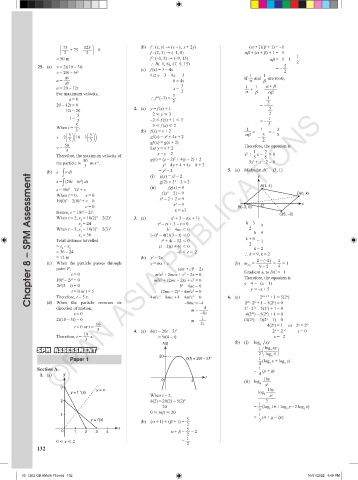
1. (a) y 4
16y
0 4 t (ii) log ——
8 x 2
3
y = x 16y
–1
y = f (x) log ——
x
When t = 2, = ————
2
2
2 h(2) = 20(2) – 5(2) 2 1 3
= 20 = —(log 16 + log y – 2 log x)
3
2
2
2
0 < h(t) < 20
1
1 = —(4 + q – 2p)
5
y = f(x) (b) (α + 1) + (β + 1) = — 3
2
x 5
0 1 2 3 4 α + β = — – 2
2
1
0 < x < 2 = —
2
132
10_1202 QB AMath F5.indd 132 10/01/2022 4:49 PM

