


Page 9 - 1202 Question Bank Grammar Form 4
P. 9
16                      Infinitives, Gerunds, and
              Chapter                                                Participles


             NOTES


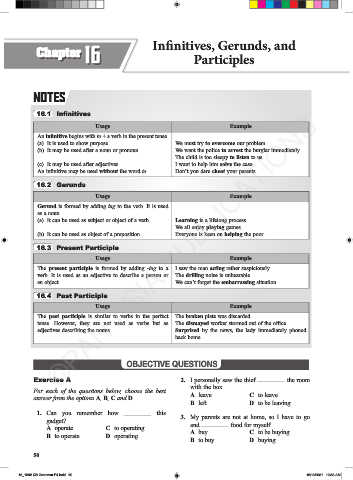
             16.1   Infinitives
                      ©PAN ASIA PUBLICATIONS
                                  Usage                                          Example

              An infinitive begins with to + a verb in the present tense.
              (a)  It is used to show purpose.                We must try to overcome our problem.
              (b)  It may be used after a noun or pronoun.    We want the police to arrest the burglar immediately.
                                                              The child is too sleepy to listen to us.
              (c)  It may be used after adjectives.           I want to help him solve the case.
              An infinitive may be used without the word to.  Don’t you dare cheat your parents.

              16.2   Gerunds

                                  Usage                                          Example
              Gerund is formed by adding ing to the verb. It is used
              as a noun.
              (a)  It can be used as subject or object of a verb.  Learning is a lifelong process.
                                                              We all enjoy playing games.
              (b)  It can be used as object of a preposition.  Everyone is keen on helping the poor.

              16.3   Present Participle
                                  Usage                                          Example
              The  present  participle is formed by adding -ing to a  I saw the man acting rather suspiciously.
              verb. It is used as an adjective to describe a person or  The drilling noise is unbearable.
              an object.                                      We can’t forget the embarrassing situation.

              16.4   Past Participle

                                  Usage                                          Example
              The  past  participle  is  similar  to  verbs  in  the  perfect  The broken plate was discarded.
              tense.  However, they  are not used as verbs but as  The dismayed worker stormed out of the office.
              adjectives describing the nouns.                Surprised  by the  news, the  lady  immediately  phoned
                                                              back home.


                                             OBJECTIVE QUESTIONS


             Exercise A                                          2.  I personally saw the thief      the room
                                                                   with the box.
             For each of the questions below, choose the best
             answer from the options A, B, C and D.                A  leave             C  to leave
                                                                   B  left              D  to be leaving
               1.  Can you remember how                this
                 gadget?                                         3.  My parents are not at home, so I have to go
                 A  operate           C  to operating              and            food for myself.
                 B  to operate        D  operating                 A  buy               C  to be buying
                                                                   B  to buy            D  buying

             50


       16_1202 QB Grammar F4.indd   50                                                                      16/12/2021   10:58 AM

