Page 6 - Spotlight A+ Form 4 & 5 Mathematics KSSM
P. 6
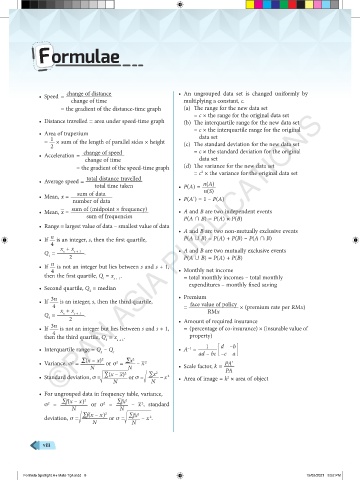
Formulae


              •  Speed =  change of distance                •  An  ungrouped  data  set  is  changed  uniformly  by
                         change of time                       multiplying a constant, c.
                     = the gradient of the distance-time graph  (a)  The range for the new data set
                                                                 = c × the range for the original data set
              •  Distance travelled = area under speed-time graph  (b)  The interquartile range for the new data set
                                                                 = c × the interquartile range for the original
              •  Area of trapezium                                 data set
                  1
                =   × sum of the length of parallel sides × height  (c)  The standard deviation for the new data set
                  2
              •  Acceleration =   change of speed                = c × the standard deviation for the original
                             change of time                        data set
                          = the gradient of the speed-time graph  (d)  The variance for the new data set
                                                                 = c  × the variance for the original data set
                                                                    2
              •  Average speed =  total distance travelled
                                total time taken            •  P(A) =   n(A)
                                                                     n(S)
                           sum of data
              •  Mean, x =   number of data                 •  P(Aʹ) = 1 – P(A)
                     
              •  Mean, x =  sum of (midpoint × frequency)    •  A and B are two independent events
                     
                              sum of frequencies
                                                              P(A ∩ B) = P(A) × P(B)
              •  Range = largest value of data – smallest value of data
                                                            •  A and B are two non-mutually exclusive events
                  n
              •  If   is an integer, s, then the first quartile,     P(A ∪ B) = P(A) + P(B) – P(A ∩ B)
                  4
                     x  + x
                                                            •  A and B are two mutually exclusive events
                             .
                      s
                Q  =  ©PAN ASIA PUBLICATIONS
                          s + 1
                 1      2                                     P(A ∪ B) = P(A) + P(B)
                  n
              •  If   is not an integer but lies between s and s + 1,   •  Monthly net income
                  4
                then the first quartile, Q = x  .             = total monthly incomes – total monthly
                                   1   s + 1
                                                                expenditures – monthly fixed saving
              •  Second quartile, Q  = median
                               2
              •  If   3n   is an integer, s, then the third quartile,   •  Premium
                  4  x  + x                                   =   face value of policy  × (premium rate per RMx)
                                                                      RMx
                Q  =   s  2  s + 1  .                       •  Amount of required insurance
                 3
              •  If   3n  is not an integer but lies between s and s + 1,     = (percentage of co-insurance) × (insurable value of
                  4
                then the third quartile, Q  = x  .              property)
                                    3   s + 1
                                                                          d  –b
                                                                          
                                                                     1
              •  Interquartile range = Q  – Q 1             •  A  =  ad – bc –c  a 
                                                               –1

                                  3
                                 x
                                                x
              •  Variance, σ  =  ∑(x – ) 2  or σ  =  ∑x 2  –  2           PAʹ
                                        2
                         2
                               N            N               •  Scale factor, k =   PA
                                                 
                                  
                                         x
              •  Standard deviation, σ =   ∑(x – ) 2  or σ =    ∑x 2  –     •  Area of image = k  × area of object
                                                        x
                                                         2
                                                                             2
                                                   N
                                       N
              •  For ungrouped data in frequency table, variance,
                                               x
                σ   =   ∑f(x – x) 2  2  ∑fx 2   –   ,  standard
                              or  σ   =
                                                2
                 2
                         N               N
                                          
                           
                                  
                                                  x
                deviation, σ =   ∑f(x – x) 2  or σ =   ∑fx 2  –  .
                                                   2
                                N
                                             N
               viii
         Formula Spotlight A+ Mate Tg4.indd   8                                                        15/03/2021   3:52 PM
   1   2   3   4   5   6   7   8   9   10   11