


Page 16 - NCAT Magazine Fall 2018
P. 16
caMPUs highlights
maranda mCBride, an The CREST Center for BioEnergy,
associate professor of directed by aBolghasem
Faculty and staff management and director of shahBaZi, received $2.1 million
the Transportation Institute
from NSF. The center aims to
in the College of Business make biomass a more viable
and Economics, was awarded source of renewable energy,
$1.4 million from the U.S. conducting fundamental research
Department of Transportation. toward the development of
The institute educates students advanced thermochemical
and professionals from diverse populations to biomass conversion technology for the efficient, economic
provide qualified transportation professionals in the production of liquid transportation fuels and hydrogen.
workforce. Institute activities are designed to provide Shahbazi is a professor in the Department of Chemical,
ongoing initiatives in the areas of education, research, Biological and Bio Engineering.
Professors solomon sameer hamoush’s and workforce development. It serves as a national,
Bililign and marC n. project, “Pipeline regional and local clearinghouse for transportation
fiddler, along with Development of Skilled education, research and outreach. leonard Williams is among
doctoral student Jaime Workforce through Research the group of researchers who
Green, collaborated on a in Advanced Manufacturing,” took part in the exhibition in
study led by researchers was awarded $2 million radiah C. minor, an the District of Columbia to help
at the University of from the U.S. Department associate professor of animal demonstrate how multiple types
Washington. The team’s of Energy. The funds will science in the College of of U.S. Department of Agriculture
research explored the be used to fabricate metal Agricultural and Environmental funding (intramural, extramural,
formation of pollution particulates containing test parts and determine material properties using a Sciences, was chosen for the competitive, and capacity) work
sulfate and nitrate in the wintertime, when they metal 3D printing machine, train students in the use 2018 Excellence in Teaching together to bolster American
are produced more slowly but spread over larger of 3D printing, collaborate with other research hubs Award for N.C. A&T. The innovation. Williams, a professor and researcher in the
geographic areas. The research was published in the on fabrication and metal properties and develop prestigious annual award College of Agriculture and Environmental Sciences and
Proceedings of the National Academy of Sciences. a workforce pipeline by offering outreach and recognized Minor, along with director of the Center for Excellence in Post-Harvest
education workshops targeting secondary education faculty representing each of the other 16 campuses in Technologies, presented “Developing Agricultural
students. Hamoush is a professor in the Department the UNC System, for bringing innovative and creative Products with Health Benefits while Supporting Small
sung-Jin Cho, an assistant professor in the of Civil, Architectural, Agricultural and
Department of Nanoengineering, is developing a Environmental Engineering. teaching methods and approaches, which make a real and Limited Resource Farmers.”
new generation of solid-state lithium batteries that difference in how students learn.
will enable electrical vehicles to basically do more guoChen yang and lu
with less. Current battery models are heavy, adding shengmin sang’s Zhongge, researcher and
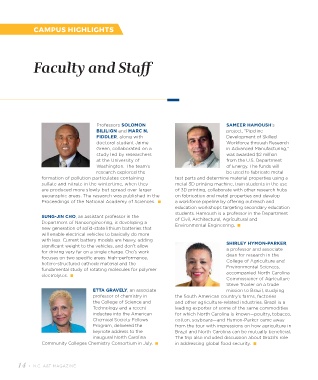
significant weight to the vehicles, and don’t allow shirley hymon-Parker, “Nutrimetabolomics Approach research assistant, respectively,
for driving very far on a single charge. Cho’s work a professor and associate to Identify the Biomarkers of in the Department of Natural
focuses on two specific areas: high-performance, dean for research in the Whole Grain Intake” project Resources and Environmental
hetero-structured cathode material and the College of Agriculture and was awarded $2.8 million Design, have received a U.S.
fundamental study of rotating molecules for polymer Environmental Sciences, from the U.S. Department of Patent for research that will
electrolytes. accompanied North Carolina
Commissioner of Agriculture Agriculture. The research will help ensure a more plentiful and
Steve Troxler on a trade identify novel bioactive natural reliable source of Alexandrian
eTTa graVely, an associate mission to Brazil, studying products that can be used in laurel (Danae Racemosa L.), an evergreen shrub in high
professor of chemistry in the South American country’s farms, factories functional foods and dietary supplements to prevent demand in the agricultural marketplace, particularly
the College of Science and and other agriculture-related industries. Brazil is a chronic diseases such as cancer and diabetes. Sang in the landscape and nursery industries. Yang and
Technology and a recent leading exporter of some of the same commodities is a professor of family and consumer sciences in the Zhonggee have found that germinating seeds in the
inductee into the American for which North Carolina is known—poultry, tobacco, College of Agriculture and Environmental Sciences. presence of cytokinnis and/or auxins increased in vitro
Chemical Society Fellows cotton, soybeans—and Hymon-Parker came away shoot multiplication and seedling quality in the shrub.
Program, delivered the from the tour with impressions on how agriculture in Ordinarily, the seed germination of Alexandrian laurel
keynote address to the Brazil and North Carolina can be mutually beneficial. often takes up to 12–18 months with a germination rate
inaugural North Carolina The trip also included discussion about Brazil’s role of only about 20 percent, taking up to six years to
Community Colleges Chemistry Consortium in July. in addressing global food security. produce a saleable one-gallon size plant.
14 • N.C. a&t MagaziNe NCat.edu • 15

