


Page 127 - KSN English Final
P. 127
in 1991. Privatisation in Malaysia has evolved and the relationship is now   PPP can deliver value for money through harnessing the private sector’s
 commonly referred to as Public and Private Partnership or PPP.   expertise in combining  the  design  and  operation  of  an  asset,  thereby
               providing services in a more efficient manner compared to traditional forms
 Generally, PPP is characterised by the sharing of risks, responsibilities   of procurement. However, careful consideration, assessment and review
 and rewards between partners. The main reasons for establishing such   need to be carried out to get the best value for money for the Government,
 partnerships  are  to  ensure  efficient  design,  construction,  operation  and   and allowing a reasonable return to the private sector due to the complex
 maintenance of infrastructure for enhanced services. PPP can deliver value   nature of PPP projects in terms of risk allocation, contract negotiation,
 for money through harnessing the private sector’s expertise in combining   detailing output specification and the key performance indicators (KPIs).
 the design and operation of an asset, thereby providing services in a more
 efficient manner compared to traditional forms of procurement.   In Malaysia, the PPP implementation framework is based on centralised
               planning and processing at the PPP Unit, Prime Minister’s Department
 PPP also provides better and faster delivery through effective allocation of   (UKAS); decentralised implementation and monitoring by the Ministries
 risks. Risks are borne by the party which is better able to manage them.   and State Governments; and negotiation/standardisation of terms and
 There is zero completion and rework risks to the Government, since design   conditions  of  concession  agreement  by  the  Public-Private  Partnership
 and construction risks are borne by the private sector. It enhances quality   Committee (JKAS). As such, there is a clear structure in terms of inter-
 delivery of services to the public, where build quality responsibilities are   agency co-ordination in the implementation of PPP projects in Malaysia.
 borne by the private sector. The Government sets the Key Performance
 Indicator (KPI) for minimum service level to ensure uncompromised service   Co-ordination  is  effected  via  the  Public-Private  Partnership  Committee
 quality. Additionally, a sinking fund is set up throughout the concession   (JKAS) and High Level Committee on Public-Private Partnership (JTAS).
 period for heavy maintenance, refurbishment and upgrading works.  These  committees  facilitate  co-ordination  between  UKAS  and  other
               relevant central agencies and stakeholders before project proposals are
 In terms of economic performance, Malaysia’s economy grew by 6.2%   presented to  the Cabinet for  decision. The  agencies and stakeholders
 for the period from 1970 to 2014. National Incidence of Poverty has   include the  Ministry of Finance,  the Economic Planning  Unit, Prime
 declined from 49.3% in 1970 to 0.1% in 2014. In addition, the economy   Minister’s Department, the  Attorney-General’s Chambers, Department
 has transformed from an agriculture-based into manufacturing and service-
 based economy. The unemployment rate has been maintained at below 4%
 since 1994, while the inflation rate remained low and stable. Needless to
 say, the private sector has contributed significantly to Malaysia’s economic
 growth in Malaysia.

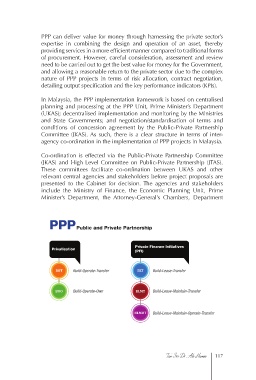
 In the Malaysian context, PPP generally includes Privatisation and Private
 Finance Initiatives (PFI). Privatisation methods include sales of assets or
 equity, corporatisation, land swap, Build-Operate-Transfer (BOT), Build-
 Operate-Own (BOO), outsourcing/management contract, and leasing.
 As for Private Finance Initiatives (PFI), the methods include Build-Lease-
 Transfer (BLT), Build-Lease-Maintain-Transfer (BLMT) and Build-Lease-
 Maintain-Operate-Transfer (BLMOT).

 The PPP structure implemented in Malaysia is carried out via a Special
 Purpose Vehicle (SPV) which acts as an operator, and typically implements
 projects by appointing construction contractors and the facilities
 management operators.


 116  Humanising The Public Service : A Compilation of Speeches by the Chief Secretary to the Government  117

