


Page 20 - Middle School Registration 2018 Web version
P. 20
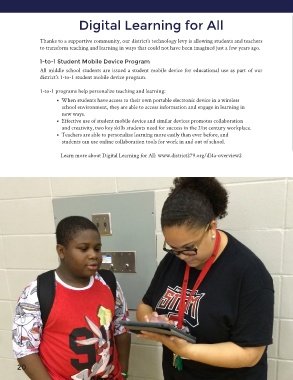
Digital Learning for All


                  Thanks to a supportive community, our district’s technology levy is allowing students and teachers
                  to transform teaching and learning in ways that could not have been imagined just a few years ago.

                  1-to-1 Student Mobile Device Program
                  All middle school students are issued a student mobile device for educational use as part of our
                  district’s 1-to-1 student mobile device program.


                  1-to-1 programs help personalize teaching and learning:
                         •  When students have access to their own portable electronic device in a wireless
                             school environment, they are able to access information and engage in learning in
                             new ways.
                         •  Effective use of student mobile device and similar devices promotes collaboration
                           and creativity, two key skills students need for success in the 21st century workplace.
                         •  Teachers are able to personalize learning more easily than ever before, and
                             students can use online collaboration tools for work in and out of school.


                          Learn more about Digital Learning for All: www.district279.org/dl4a-overview2
                                                                                                                                            Schoology
                                                                                                                                            Schoology  is  a web-based learning management system  that  supports  online learning,
                                                                                                                                            communication,  and  collaboration among teachers,  students,  and  families.  With  Schoology,
                                                                                                                                            students  can  access  homework  and class  resources  anytime,  anywhere.  It’s  much  easier  for
                                                                                                                                            students  to  keep  their  homework assignments  organized in  Schoology than  in  their  locker.
                                                                                                                                            Schoology means fewer assignments lost; richer conversations and support when students have
                                                                                                                                            questions; and greater access to study tools.

                                                                                                                                            Students and staff access Schoology through a web browser by visiting osseo.schoology.com and
                                                                                                                                            logging in with their ISD 279 network username and password. Student and staff iPads also have
                                                                                                                                            the Schoology iOS app installed. Learn more about Schoology:

                                                                                                                                                                       www.district279.org/schoology


                                                                                                                                            Classroom Technology
                                                                                                                                            Many of  our  classrooms  have  voice  distribution  systems  that  amplify the  teacher’s  voice  in
                                                                                                                                            a way that helps ensure that all students can hear, regardless of where they are seated. Voice
                                                                                                                                            amplification systems contribute to improved student learning, increased attention, and less
                                                                                                                                            vocal strain.


                                                                                                                                            All classrooms have digital projection systems and many have interactive whiteboards that allow
                                                                                                                                            teachers to display information from a computer to the entire class.

                                                                                                                                            Some classrooms have hand-held student-response systems that allow students to respond to
                                                                                                                                            questions privately so that only their teacher can see how well they are grasping the material
                                                                                                                                            being taught. These systems allow teachers to gather real-time data about how students are
                                                                                                                                            doing so that they can quickly adjust instruction in response to student needs.


        20                                                                                                                                                                                                                                  21

