


Page 9 - 2021 TAA Magazine
P. 9
“It is vital that we take
                                                                                           care of our Thorough-
                                                                                           breds both during and
                                                                                           after their careers. For
                                                                                           all the opinions, ideas,
                                                                                           and strategies about
                                                                                           promoting the future
                                                                                           health of the Thor-
                                                                                           oughbred industry, I
                                                                                           think every breeder
                                                                                           and stallion owner
                                                                                           can agree on one
                                                                                           thing: Horses are our
                                                                                           lifeblood. As the ones
                                                                                           who are engaged in
                                                                                           the breeding of horses,
                                                                                           we breeders and stal-
                                                                                           lion owners have the
                                                                                           responsibility to do
                                                                              suzie PiCou oldham  more for these animals.
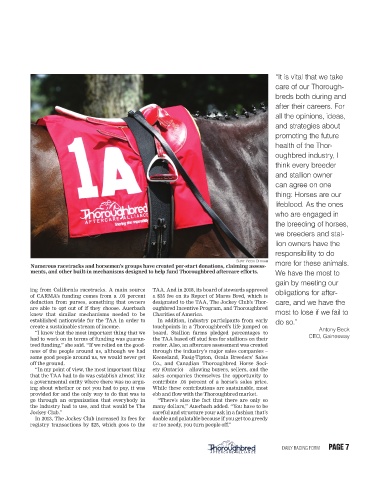
           Numerous racetracks and horsemen’s groups have created per-start donations, claiming assess-
           ments, and other built-in mechanisms designed to help fund Thoroughbred aftercare efforts.   We have the most to
                                                                                           gain by meeting our
           ing from California racetracks. A main source   TAA. And in 2018, its board of stewards approved   obligations for after-
           of CARMA’s funding comes from a .03 percent   a $35 fee on its Report of Mares Bred, which is
           deduction from purses, something that owners   designated to the TAA, The Jockey Club’s Thor-  care, and we have the
           are able to opt out of if they choose. Auerbach   oughbred Incentive Program, and Thoroughbred
           knew that similar mechanisms needed to be   Charities of America.               most to lose if we fail to
           established nationwide for the TAA in order to   In addition, industry participants from early   do so.”
           create a sustainable stream of income.  touchpoints in a Thoroughbred’s life jumped on        Antony Beck
            “I knew that the most important thing that we   board. Stallion farms pledged percentages to
           had to work on in terms of funding was guaran-  the TAA based off stud fees for stallions on their   CEO, Gainesway
           teed funding,” she said. “If we relied on the good-  roster. Also, an aftercare assessment was created
           ness of the people around us, although we had   through the industry’s major sales companies –
           some good people around us, we would never get   Keeneland, Fasig-Tipton, Ocala Breeders’ Sales
           off the ground.                         Co., and Canadian Thoroughbred Horse Soci-
            “In my point of view, the most important thing   ety (Ontario) – allowing buyers, sellers, and the
           that the TAA had to do was establish almost like   sales  companies  themselves  the  opportunity  to
           a governmental entity where there was no argu-  contribute .05 percent of a horse’s sales price.
           ing about whether or not you had to pay, it was   While these contributions are sustainable, most
           provided for and the only way to do that was to   ebb and flow with the Thoroughbred market.
           go through an organization that everybody in   “There’s also the fact that there are only so
           the industry had to use, and that would be The   many dollars,” Auerbach added. “You have to be
           Jockey Club.”                           careful and structure your ask in a fashion that’s
            In 2013, The Jockey Club increased its fees for   doable and palatable because if you get too greedy
           registry transactions by $25, which goes to the   or too needy, you turn people off.”


                                                                                             DAILY RACING FORM        PAGE 7

