


Page 136 - Hunter - The Vigil
P. 136
E
                                                                      I
                                                                  H
                                                                C
                                                                C
                                                          H
                                                                          O
                                                                                G
                                                                            N
                                                        T THE CHEIRON GROUP (CONSPIRACY)
                                                                        R

                                                                                                   S
                                                                                       P
                                                                                 R
                                                                                     U
                                                                                                     P
                                                                C
                                                                C
                                                            E
                                                                                                       I
                                                                                                           A
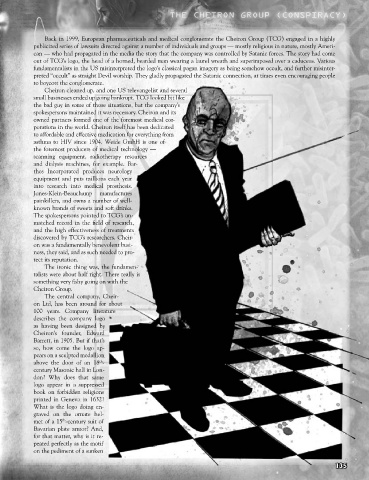
                Back in 1999, European pharmaceuticals and medical conglomerate the Cheiron Group (TCG) engaged in a highly
            publicized series of lawsuits directed against a number of individuals and groups — mostly religious in nature, mostly Ameri-
            can — who had propagated in the media the story that the company was controlled by Satanic forces. The story had come
            out of TCG’s logo, the head of a horned, bearded man wearing a laurel wreath and superimposed over a caduceus. Various
            fundamentalists in the US misinterpreted the logo’s classical pagan imagery as being somehow occult, and further misinter-
            preted “occult” as straight Devil worship. They gladly propagated the Satanic connection, at times even encouraging people
            to boycott the conglomerate.
                Cheiron cleaned up, and one US televangelist and several
            small businesses ended up going bankrupt. TCG looked bit like
            the bad guy in some of those situations, but the company’s
            spokespersons maintained it was necessary. Cheiron and its
            owned partners formed one of the foremost medical cor-
            porations in the world. Cheiron itself has been dedicated
            to affordable and effective medication for everything from
            asthma to HIV since 1904. Weide GmbH is one of
            the foremost producers of medical technology —
            scanning equipment, radiotherapy resources
            and dialysis machines, for example. Bar-
            thes Incorporated produces neurology
            equipment and puts millions each year
            into research into medical prosthesis.
            Jones-Klein-Beauchamp  manufactures
            painkillers, and owns a number of well-
            known brands of sweets and soft drinks.
            The spokespersons pointed to TCG’s un-
            matched record in the field of research,

            and the high effectiveness of treatments
            discovered by TCG’s researchers. Cheir-
            on was a fundamentally benevolent busi-
            ness, they said, and as such needed to pro-
            tect its reputation.
                The ironic thing was, the fundamen-
            talists were about half right. There really is
            something very fi shy going on with the
            Cheiron Group.
                The central company, Cheir-
            on Ltd, has been around for about
            100 years. Company literature
            describes the company logo
            as having been designed by
            Cheiron’s founder, Edward
            Barrett, in 1905. But if that’s
            so, how come the logo ap-
            pears on a sculpted medallion
                                  th
            above the door of an 18 -
            century Masonic hall in Lon-
            don? Why does that same
            logo appear in a suppressed
            book on forbidden religions
            printed in Geneva in 1632?
            What is the logo doing en-
            graved on the ornate hel-
                     th
            met of a 15 -century suit of
            Bavarian plate armor? And,
            for that matter, why is it re-
            peated perfectly as the motif
            on the pediment of a sunken

                                                                                                               135
                                                                                                               135

