


Page 144 - Hunter - The Vigil
P. 144
U
E
S
S
S
I
C
R
L
L
(
S
R
A
I I IRACY)
M
U
I
M
A
I
L
N
S
O
N
P
M M MALLEUS MALIFICARUM (CONSPI R A C Y )
S
P
C
)
A
Y
A
O
The idea of the Inquisitor, the Catholic witch-hunter of the Middle Ages, is potent: the grim-faced man with brands and
scourges, thumbscrews and chains, who burns, strangles and drowns innocent and guilty alike to find the truth. It might be
easy to sigh in relief: these things don’t happen anymore, do they?
Of course they do. There are still witch-hunters, still empowered secretly by the Church. The Inquisition has become
the somewhat more benevolent Congregation for the Doctrine of the Faith. The witch-
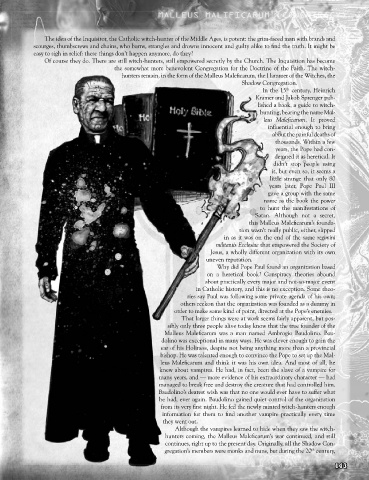
hunters remain, in the form of the Malleus Maleficarum, the Hammer of the Witches, the
Shadow Congregation.
In the 15 century, Heinrich
th
Kramer and Jakob Sprenger pub-
lished a book, a guide to witch-
hunting, bearing the name Mal-
leus Maleficarum. It proved
influential enough to bring
about the painful deaths of
thousands. Within a few
years, the Pope had con-
demned it as heretical. It
didn’t stop people using
it, but even so, it seems a
little strange that only 80
years later, Pope Paul III
gave a group with the same
name as the book the power
to hunt the manifestations of
Satan. Although not a secret,
this Malleus Maleficarum’s founda-
tion wasn’t really public, either, slipped
in as it was on the end of the same regimini
militantis Ecclesiae that empowered the Society of
Jesus, a wholly different organization with its own
uneven reputation.
Why did Pope Paul found an organization based
on a heretical book? Conspiracy theories abound
about practically every major and not-so-major event
in Catholic history, and this is no exception. Some theo-
ries say Paul was following some private agenda of his own;
others reckon that the organization was founded as a dummy in
order to make some kind of point, directed at the Pope’s enemies.
That larger things were at work seems fairly apparent, but pos-
sibly only three people alive today know that the true founder of the
Malleus Maleficarum was a man named Ambrogio Baudolino. Bau-
dolino was exceptional in many ways. He was clever enough to gain the
ear of his Holiness, despite not being anything more than a provincial
bishop. He was talented enough to convince the Pope to set up the Mal-
leus Maleficarum and think it was his own idea. And most of all, he
knew about vampires. He had, in fact, been the slave of a vampire for
many years, and — more evidence of his extraordinary character — had
managed to break free and destroy the creature that had controlled him.
Baudolino’s dearest wish was that no one would ever have to suffer what
he had, ever again. Baudolino gained quiet control of the organization
from its very first night. He fed the newly minted witch-hunters enough
information for them to find another vampire practically every time
they went out.
Although the vampires learned to hide when they saw the witch-
hunters coming, the Malleus Maleficarum’s war continued, and still
continues, right up to the present day. Originally, all the Shadow Con-
th
gregation’s members were monks and nuns, but during the 20 century,
143
143

