


Page 37 - Hunter - The Vigil
P. 37
S
A
T
B
B
A
S
W
S
C
C
Y
R
E
R
F
I
L
T
Y
H
I
G
E
T
E
R
R
C CHAPTER ONE: SHADOWS CAST BY FIRELIGHT
H
A
T
P
E
D
D
O
W
O
A
:
S
A
H
until the individual or cell finds itself branded by its ac-
tions. From that moment forward, it is looked at with a
suspicious eye, and if the hunter or hunters compound
this betrayal with still more dishonesty, they risk becom-
ing too untrustworthy to deal with. Such a case happened
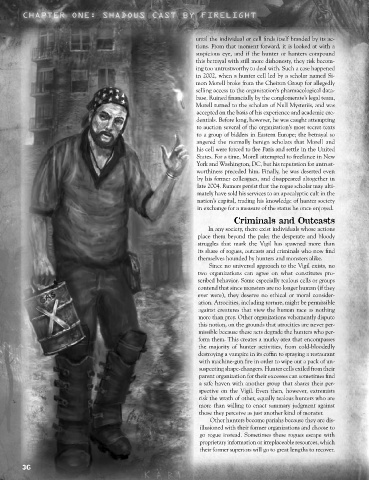
in 2002, when a hunter cell led by a scholar named Si-
mon Morell broke from the Cheiron Group for allegedly
selling access to the organization’s pharmacological data-
base. Ruined financially by the conglomerate’s legal team,
Morell turned to the scholars of Null Mysteriis, and was
accepted on the basis of his experience and academic cre-
dentials. Before long, however, he was caught attempting
to auction several of the organization’s most secret texts
to a group of bidders in Eastern Europe; the betrayal so
angered the normally benign scholars that Morell and
his cell were forced to flee Paris and settle in the United
States. For a time, Morell attempted to freelance in New
York and Washington, DC, but his reputation for untrust-
worthiness preceded him. Finally, he was deserted even
by his former colleagues, and disappeared altogether in
late 2004. Rumors persist that the rogue scholar may ulti-
mately have sold his services to an apocalyptic cult in the
nation’s capital, trading his knowledge of hunter society
in exchange for a measure of the status he once enjoyed.
Criminals and Outcasts
In any society, there exist individuals whose actions
place them beyond the pale; the desperate and bloody
struggles that mark the Vigil has spawned more than
its share of rogues, outcasts and criminals who now find
themselves hounded by hunters and monsters alike.
Since no universal approach to the Vigil exists, no
two organizations can agree on what constitutes pro-
scribed behavior. Some especially zealous cells or groups
contend that since monsters are no longer human (if they
ever were), they deserve no ethical or moral consider-
ation. Atrocities, including torture, might be permissible
against creatures that view the human race as nothing
more than prey. Other organizations vehemently dispute
this notion, on the grounds that atrocities are never per-
missible because these acts degrade the hunters who per-
form them. This creates a murky area that encompasses
the majority of hunter activities, from cold-bloodedly
destroying a vampire in its coffin to spraying a restaurant
with machine-gun fi re in order to wipe out a pack of un-
suspecting shape-changers. Hunter cells exiled from their
parent organization for their excesses can sometimes find
a safe haven with another group that shares their per-
spective on the Vigil. Even then, however, extremists
risk the wrath of other, equally zealous hunters who are
more than willing to enact summary judgment against
those they perceive as just another kind of monster.
Other hunters become pariahs because they are dis-
illusioned with their former organizations and choose to
go rogue instead. Sometimes these rogues escape with
proprietary information or irreplaceable resources, which
their former superiors will go to great lengths to recover.
36
36

