


Page 15 - Education February 2022 final_Neat
P. 15
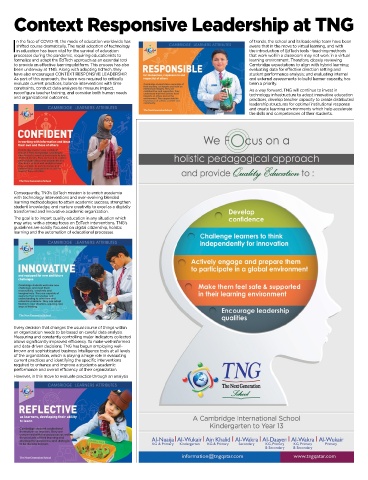
Context Responsive Leadership at TNG


        n the face of COVID-19, the mode of education worldwide has                                    of trends, the school and its leadership team have been
        shifted course dramatically. The rapid adoption of technology                                  aware that in the move to virtual learning, and with
      Iin education has been vital for the survival of education                                       the introduction of EdTech tools - teaching methods
       processes during the pandemic, requiring educationists to                                       that work well in a classroom may not work in a virtual
       formalize and adapt the EdTech approach as an essential tool                                    learning environment. Therefore, closely reviewing
       to provide an effective learning platform. This process has also                                Cambridge expectations to align with hybrid learning;
       been underway at TNG. Along with adopting EdTech, they                                          evaluating data for effective direction setting and
       have also encouraged CONTEXT RESPONSIVE LEADERSHIP.                                             student performance analysis; and evaluating internal
       As part of this approach, the team was required to critically                                   and external assessments to build learner capacity, has
       evaluate current practices, balance interventions with time                                     been a priority.
       constraints, conduct data analyses to measure impact,                                           As a way forward, TNG will continue to invest in
       reconfigure teacher training, and consider both human needs                                     technology infrastructure to adopt innovative education
       and organizational outcomes.
                                                                                                       practices, develop teacher capacity to create distributed
                                                                                                       leadership structures for optimal institutional response
                                                                                                       and create learning environments which help accelerate
                                                                                                       the skills and competencies of their students.


       Consequently, TNG’s EdTech mission is to enrich academia
       with technology interventions and ever-evolving blended
       learning methodologies to attain academic success, strengthen
       student knowledge, and nurture creativity to excel as a digitally
       transformed and innovative academic organization.
       The goal is to impart quality education in any situation which
       may arise, with a strong focus on EdTech interventions. TNG’s
       guidelines are solidly focused on digital citizenship, holistic
       learning and the automation of educational processes.


       Every decision that changes the usual course of things within
       an organization needs to be based on careful data analysis.
       Measuring and constantly controlling major indicators collected
       allows significantly improved efficiency. To make well-informed
       and data-driven decisions, TNG has begun employing well-
       known and sophisticated business intelligence tools at all levels
       of the organization, which is playing a huge role in evaluating
       current practices and identifying the specific interventions
       required to enhance and improve a student›s academic
       performance and overall efficiency of their organization.
       However, in this move to evaluate practice through an analysis

