


Page 118 - Towards Trustworthy Elections New Directions in Electronic Voting by Ed Gerck (auth.), David Chaum, Markus Jakobsson, Ronald L. Rivest, Peter Y. A. Ryan, Josh Benaloh, Miroslaw Kutylowski, Ben Adida ( (z-lib.org (1)
P. 118
A. Otsuka and H. Imai
                          110
                          shares held by the shareholders. Thus, in our setting, each verifier (shareholder)
                          also has an information theoretic advantage over the prover. Using this infor-
                          mation theoretic advantage of the verifiers, we can verify the correctness of a
                          polynomial posted by the prover.
                          Definition 1. (Verification) For a polynomial f ∈F generated by the prover,
                          the polynomial f is called accepted by a verifier V i , if and only if the polynomial
                          f satisfies y i = f(x i ).
                          A polynomial f is evaluated by the verifier V i whether the polynomial f passes
                          through a hidden point (x i ,y i ). Obviously, there are many polynomials possibly
                          accepted by the verifier. However, since the evaluation point is hidden, there
                          exists no better way than a random guess for the prover to find a good polynomial
                          f  = f 0 to be accepted by the verifier. From this discussion, we have the following
                          lemmas.
                          Lemma 1. (Integrity) For any adversary A who may collapse the prover and
                          all the verifiers except for the targeted verifier V i , the success probability that
                          the adversary A to force the verifier V i accept a wrong polynomial f  = f 0 is

                          exponentially small with security parameter k.
                          This lemma implies that once the verifier V i accepted a polynomial f(x) ∈F,
                          then the polynomial is correct, f(x)= f 0 (x) for all x ∈ GF(p), with high
                          probability. Thus, we have the following corollary.
                          Corollary 1. (Unanimity) Suppose that a polynomial f ∈F is accepted by a
                          honest verifier V i , then the probability that another honest verifier V j to reject
                          the same polynomial f is exponentially small.

                          Now we turn to the security for the prover. The polynomial f 0 given to the
                          prover is unconditionally hidden from the verifiers colluding of up to ω verifiers.

                          Lemma 2. (Secrecy) Suppose that the prover has a polynomial f 0 ∈F of degree
                          ω, and that we have any adversary A that have control over up to ω verifiers
                          with hidden points {(x 1 ,y 1 ),..., (x ω ,y ω )}. Then, the success probability for the
                          adversary A to compute f ∈F such that f will be accepted by at least one
                          non-colluding verifier is exponentially small.
                          Further, we introduce homomorphic property to the above scheme. As in many
                          multiparty computation defined over polynomial-based secret sharing schemes,
                          the above stated polynomial-based hidden point technique can also be equipped
                          with homomorphic property. Observe that for any two polynomials f 1 (x), f 2 (x) ∈
                          F and two points on each polynomial (v i ,f 1 (v i )) and (v i ,f 2 (v i )), any linear
                          combination of the two polynomials g(x)= af 1(x)+ bf 2(x)with a, b in GF(q)
                          satisfies the following equation:

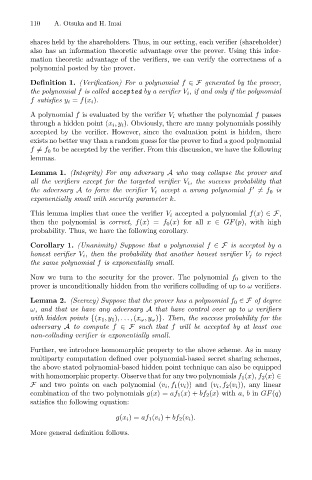
                                                 g(x i )= af 1 (v i )+ bf 2(v i ).

                          More general definition follows.

