


Page 179 - Towards Trustworthy Elections New Directions in Electronic Voting by Ed Gerck (auth.), David Chaum, Markus Jakobsson, Ronald L. Rivest, Peter Y. A. Ryan, Josh Benaloh, Miroslaw Kutylowski, Ben Adida ( (z-lib.org (1)
P. 179
The Vector-Ballot Approach for Online Voting Procedures
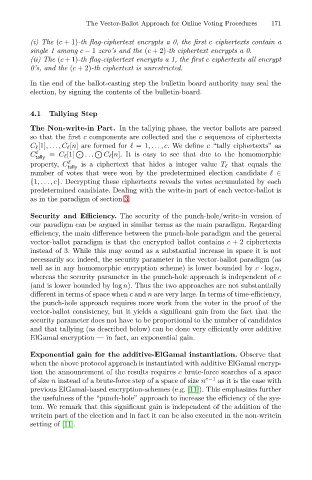
                          (i) The (c +1)-th flag-ciphertext encrypts a 0, the first c ciphertexts contain a
                          single 1 among c − 1 zero’s and the (c +2)-th ciphertext encrypts a 0.
                          (ii) The (c +1)-th flag-ciphertext encrypts a 1, the first c ciphertexts all encrypt
                          0’s, and the (c +2)-th ciphertext is unrestricted.                171
                          In the end of the ballot-casting step the bulletin board authority may seal the
                          election, by signing the contents of the bulletin-board.
                          4.1  Tallying Step
                          The Non-write-in Part. In the tallying phase, the vector ballots are parsed
                          so that the first c components are collected and the c sequences of ciphertexts
                          C   [1],... ,C   [n] are formed for   =1,...,c. We define c “tally ciphertexts” as
                               = C   [1]        C   [n]. It is easy to see that due to the homomorphic
                          C              ...
                           tally
                                        is a ciphertext that hides a integer value T   that equals the

                          property, C
                                    tally
                          number of votes that were won by the predetermined election candidate   ∈
                          {1,...,c}. Decrypting these ciphertexts reveals the votes accumulated by each
                          predetermined candidate. Dealing with the write-in part of each vector-ballot is
                          as in the paradigm of section 3.
                          Security and Efficiency. The security of the punch-hole/write-in version of
                          our paradigm can be argued in similar terms as the main paradigm. Regarding
                          efficiency, the main difference between the punch-hole paradigm and the general
                          vector-ballot paradigm is that the encrypted ballot contains c + 2 ciphertexts
                          instead of 3. While this may sound as a substantial increase in space it is not
                          necessarily so: indeed, the security parameter in the vector-ballot paradigm (as
                          well as in any homomorphic encryption scheme) is lower bounded by c · log n,

                          whereas the security parameter in the punch-hole approach is independent of c
                          (and is lower bounded by log n). Thus the two approaches are not substantially
                          different in terms of space when c and n are very large. In terms of time-efficiency,
                          the punch-hole approach requires more work from the voter in the proof of the
                          vector-ballot consistency, but it yields a significant gain from the fact that the
                          security parameter does not have to be proportional to the number of candidates
                          and that tallying (as described below) can be done very efficiently over additive
                          ElGamal encryption — in fact, an exponential gain.

                          Exponential gain for the additive-ElGamal instantiation. Observe that
                          when the above protocol approach is instantiated with additive ElGamal encryp-
                          tion the announcement of the results requires c brute-force searches of a space
                                                                          c−1
                          of size n instead of a brute-force step of a space of size n  as it is the case with
                          previous ElGamal-based encryption-schemes (e.g. [11]). This emphasizes further
                          the usefulness of the “punch-hole” approach to increase the efficiency of the sys-
                          tem. We remark that this significant gain is independent of the addition of the
                          writein part of the election and in fact it can be also executed in the non-writein
                          setting of [11].

