


Page 212 - Towards Trustworthy Elections New Directions in Electronic Voting by Ed Gerck (auth.), David Chaum, Markus Jakobsson, Ronald L. Rivest, Peter Y. A. Ryan, Josh Benaloh, Miroslaw Kutylowski, Ben Adida ( (z-lib.org (1)
P. 212
P.Y.A. Ryan and T. Peacock
                          204
                            Another possible vulnerability of the Chaum scheme, not identified in [11], but
                          mentioned in [21], is as follows. The machine attempts to corrupt the vote value
                          by incorrectly constructing one of the layers. If the voter chooses the other layer
                          for retention, the corruption will go undetected. However, if the voter chooses
                          the corrupted layer (which would lead to detection), the machine could try to
                          fool the voter by printing “destroy” instead of “retain” on the layer that the
                          voter chose as the receipt. If the voter fails to notice this, or simply ignores it,
                          the corruption will again pass undetected. This is another way that a corrupt
                          machine could undermine the “cut-and-choose” element of the protocol. Even if
                          the voter does notice the switch and is confident that they are right, it may be
                          difficult to demonstrate this to a voting official.
                          Mitigation. We refer the reader to [11] or [23] for suggested mitigations. The
                          obvious approach is to try to ensure that voters understand the procedures and
                          appreciate their motivation. This is similar to the notion of instilling a “security
                          culture” in an organisation. In practice of course, this may not really be feasible.
                          In the context of an election system, where the set of users can be vast and usage
                          infrequent, the possibilities for voter eduction is limited.
                            An alternative solution is to make the voter experience much simpler, as with
                          Prˆet `a Voter. However such simplicity seems to be at the cost of needing to place
                          more trust in the system.


                          3.3  Denial of Service

                          There are several ways in which DoS attacks could disrupt or invalidate an
                          election. See [11] for a discussion. For all such attacks, adequate error-handling
                          and recovery strategies need to be in place. In addition, some form of back-up
                          is desirable, e.g. a voter-verifiable paper audit trail (VVPAT) [15]. We return to
                          these attacks and counter-measures later, when we examine the robustness of
                          Prˆet `aVoter.


                          4   The Prˆet ` Voter Scheme
                                         a
                          We now present an overview of the Prˆet `a Voter scheme. For full details see [6].
                          Prˆet `a Voter is inspired by the Chaum scheme, but replaces the visual crypto-
                          graphic techniques with a conceptually and technologically simpler mechanism
                          to represent the encrypted vote value in the ballot receipt. In the polling station,
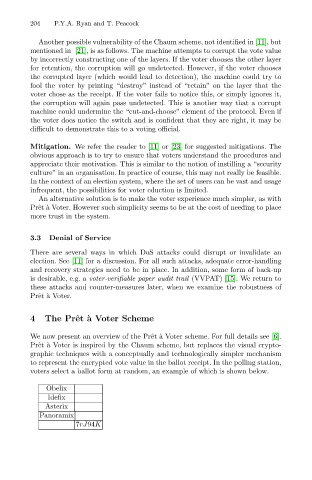
                          voters select a ballot form at random, an example of which is shown below.

                              Obelix
                               Idefix
                              Asterix
                            Panoramix
                                      7rJ94K

