


Page 301 - Towards Trustworthy Elections New Directions in Electronic Voting by Ed Gerck (auth.), David Chaum, Markus Jakobsson, Ronald L. Rivest, Peter Y. A. Ryan, Josh Benaloh, Miroslaw Kutylowski, Ben Adida ( (z-lib.org (1)
P. 301
Verifying Privacy-Type Properties of Electronic Voting Protocols: A Taster
                                         plain processes
                              P, Q, R :=
                                  0
                                                                     P
                                  in(u, x).P
                                                                     A | B
                                  out(u, N).P                   A, B, C := extended processes  293
                                                                     νn.A
                                  if M = N then P else Q
                                                                     νx.A
                                  P | Q                               M
                                                                     { / x}
                                  !P
                                  νn.P
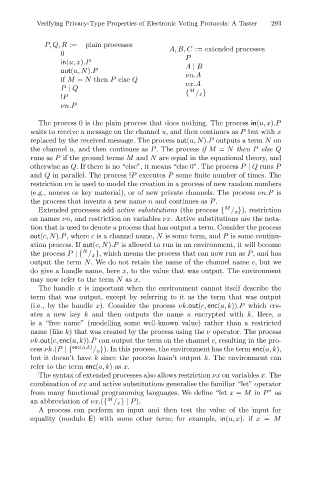
                            The process 0 is the plain process that does nothing. The process in(u, x).P
                          waits to receive a message on the channel u, and then continues as P but with x
                          replaced by the received message. The process out(u, N).P outputs a term N on
                          the channel u, and then continues as P. The process if M = N then P else Q
                          runs as P if the ground terms M and N are equal in the equational theory, and
                          otherwise as Q. If there is no “else”, it means “else 0”. The process P | Q runs P
                          and Q in parallel. The process !P executes P some finite number of times. The
                          restriction νn is used to model the creation in a process of new random numbers
                          (e.g., nonces or key material), or of new private channels. The process νn.P is
                          the process that invents a new name n and continues as P.
                                                                               M
                            Extended processes add active substitutions (the process { / x }), restriction
                          on names νn, and restriction on variables νx. Active substitutions are the nota-
                          tion that is used to denote a process that has output a term. Consider the process
                          out(c, N).P,where c is a channel name, N is some term, and P is some continu-
                          ation process. If out(c, N).P is allowed to run in an environment, it will become
                                        N
                          the process P |{ / x }, which means the process that can now run as P, and has
                          output the term N. We do not retain the name of the channel name c, but we
                          do give a handle name, here x, to the value that was output. The environment
                          may now refer to the term N as x.
                            The handle x is important when the environment cannot itself describe the
                          term that was output, except by referring to it as the term that was output
                          (i.e., by the handle x). Consider the process νk.out(c, enc(a, k)).P which cre-
                          ates a new key k and then outputs the name a encrypted with k. Here, a
                          is a “free name” (modelling some well-known value) rather than a restricted
                          name (like k) that was created by the process using the ν operator. The process
                          νk.out(c, enc(a, k)).P can output the term on the channel c, resulting in the pro-
                                     enc(a,k)
                          cess νk.(P |{    / x }). In this process, the environment has the term enc(a, k),
                          but it doesn’t have k since the process hasn’t output k. The environment can
                          refer to the term enc(a, k)as x.
                            The syntax of extended processes also allows restriction νx on variables x.The
                          combination of νx and active substitutions generalise the familiar “let” operator
                          from many functional programming languages. We define “let x = M in P”as
                                               M
                          an abbreviation of νx.({ / x }| P).
                            A process can perform an input and then test the value of the input for
                          equality (modulo E) with some other term; for example, in(u, x). if x = M

