


Page 326 - Towards Trustworthy Elections New Directions in Electronic Voting by Ed Gerck (auth.), David Chaum, Markus Jakobsson, Ronald L. Rivest, Peter Y. A. Ryan, Josh Benaloh, Miroslaw Kutylowski, Ben Adida ( (z-lib.org (1)
P. 326
R. Joaquim, C. Ribeiro, and P. Ferreira
                          318


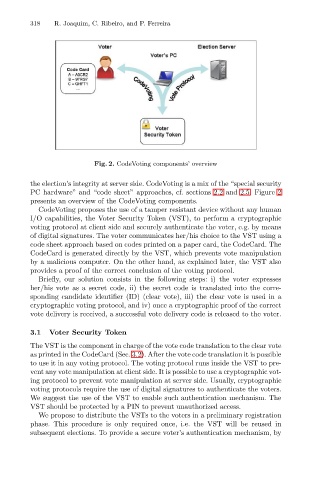
                                           Fig. 2. CodeVoting components’ overview


                          the election’s integrity at server side. CodeVoting is a mix of the “special security
                          PC hardware” and “code sheet” approaches, cf. sections 2.2 and 2.5. Figure 2
                          presents an overview of the CodeVoting components.
                            CodeVoting proposes the use of a tamper resistant device without any human
                          I/O capabilities, the Voter Security Token (VST), to perform a cryptographic
                          voting protocol at client side and securely authenticate the voter, e.g. by means
                          of digital signatures. The voter communicates her/his choice to the VST using a
                          code sheet approach based on codes printed on a paper card, the CodeCard. The
                          CodeCard is generated directly by the VST, which prevents vote manipulation
                          by a malicious computer. On the other hand, as explained later, the VST also
                          provides a proof of the correct conclusion of the voting protocol.
                            Briefly, our solution consists in the following steps: i) the voter expresses
                          her/his vote as a secret code, ii) the secret code is translated into the corre-
                          sponding candidate identifier (ID) (clear vote), iii) the clear vote is used in a
                          cryptographic voting protocol, and iv) once a cryptographic proof of the correct
                          vote delivery is received, a successful vote delivery code is released to the voter.

                          3.1  Voter Security Token

                          The VST is the component in charge of the vote code translation to the clear vote
                          as printed in the CodeCard (Sec. 3.2). After the vote code translation it is possible
                          to use it in any voting protocol. The voting protocol runs inside the VST to pre-
                          vent any vote manipulation at client side. It is possible to use a cryptographic vot-
                          ing protocol to prevent vote manipulation at server side. Usually, cryptographic
                          voting protocols require the use of digital signatures to authenticate the voters.
                          We suggest the use of the VST to enable such authentication mechanism. The
                          VST should be protected by a PIN to prevent unauthorized access.
                            We propose to distribute the VSTs to the voters in a preliminary registration
                          phase. This procedure is only required once, i.e. the VST will be reused in
                          subsequent elections. To provide a secure voter’s authentication mechanism, by

