


Page 333 - Towards Trustworthy Elections New Directions in Electronic Voting by Ed Gerck (auth.), David Chaum, Markus Jakobsson, Ronald L. Rivest, Peter Y. A. Ryan, Josh Benaloh, Miroslaw Kutylowski, Ben Adida ( (z-lib.org (1)
P. 333
325
                                              Improving Remote Voting Security with CodeVoting
                          00001 to 00009. In this case, the vote code for all candidates only differs in the
                          last digit; therefore, an attacker willing to change the voter’s vote to another
                                                                                             8
                          candidate would have a Probability of Guessing a Valid Vote Code Pgvvc =
                                                                                             25
                          i.e. 32% of success in the first try. This probability can be reduced by increasing ,
                          the domain of the vote codes, e.g. by using capital and non-capital letters. With
                          this example it is clear that the candidate IDs should be as different as possible
                          to minimize the probability of an attacker guessing a valid vote code from the
                          one typed in by the voter, e.g. 02536, 63875 and other IDs where all digits in
                          the same positions are different.
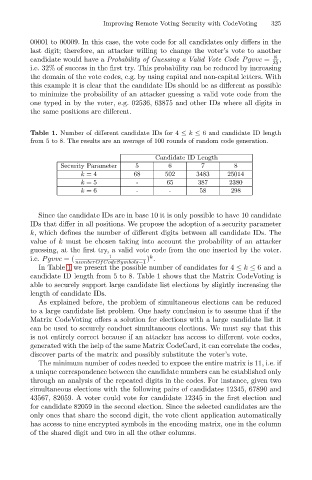
                          Table 1. Number of different candidate IDs for 4 ≤ k ≤ 6 and candidate ID length
                          from 5 to 8. The results are an average of 100 rounds of random code generation.
                                                            Candidate ID Length
                                  Security Parameter   5        6        7        8
                                        k =4          68       502      3483    25014
                                        k =5           -       65       387      2380
                                        k =6           -        -        58      298


                            Since the candidate IDs are in base 10 it is only possible to have 10 candidate
                          IDs that differ in all positions. We propose the adoption of a security parameter
                          k, which defines the number of different digits between all candidate IDs. The
                          value of k must be chosen taking into account the probability of an attacker
                          guessing, at the first try, a valid vote code from the one inserted by the voter.
                                                           k
                          i.e. Pgvvc =(         1         ) .
                                      numberOfCodeSymbols−1
                            In Table 1 we present the possible number of candidates for 4 ≤ k ≤ 6and a
                          candidate ID length from 5 to 8. Table 1 shows that the Matrix CodeVoting is
                          able to securely support large candidate list elections by slightly increasing the
                          length of candidate IDs.
                            As explained before, the problem of simultaneous elections can be reduced
                          to a large candidate list problem. One hasty conclusion is to assume that if the
                          Matrix CodeVoting offers a solution for elections with a large candidate list it
                          can be used to securely conduct simultaneous elections. We must say that this
                          is not entirely correct because if an attacker has access to different vote codes,
                          generated with the help of the same Matrix CodeCard, it can correlate the codes,
                          discover parts of the matrix and possibly substitute the voter’s vote.
                            The minimum number of codes needed to expose the entire matrix is 11, i.e. if
                          a unique correspondence between the candidate numbers can be established only
                          through an analysis of the repeated digits in the codes. For instance, given two
                          simultaneous elections with the following pairs of candidates 12345, 67890 and
                          43567, 82059. A voter could vote for candidate 12345 in the first election and
                          for candidate 82059 in the second election. Since the selected candidates are the
                          only ones that share the second digit, the vote client application automatically
                          has access to nine encrypted symbols in the encoding matrix, one in the column
                          of the shared digit and two in all the other columns.

